
How to Boost Visibility with a Clear SEO and GEO Strategy

The future of online business is no longer just about ranking on Google.
With AI engines like Google Gemini and ChatGPT shaping how answers appear, businesses need a strategy that works in both search and AI generated results. That is where SEO and GEO come together.
In this guide, I’ll show you how to build a smart SEO and GEO strategy using the same approach I follow with Semrush One, my all-in-one platform for search and AI visibility.
But first, a quick introduction:
What are SEO and GEO?
As you probably already know, SEO involves practices and tactics that can boost your website’s presence in search results.
We’re talking about good old-fashioned Search Engine Results Pages (SERPs) on Google, like:
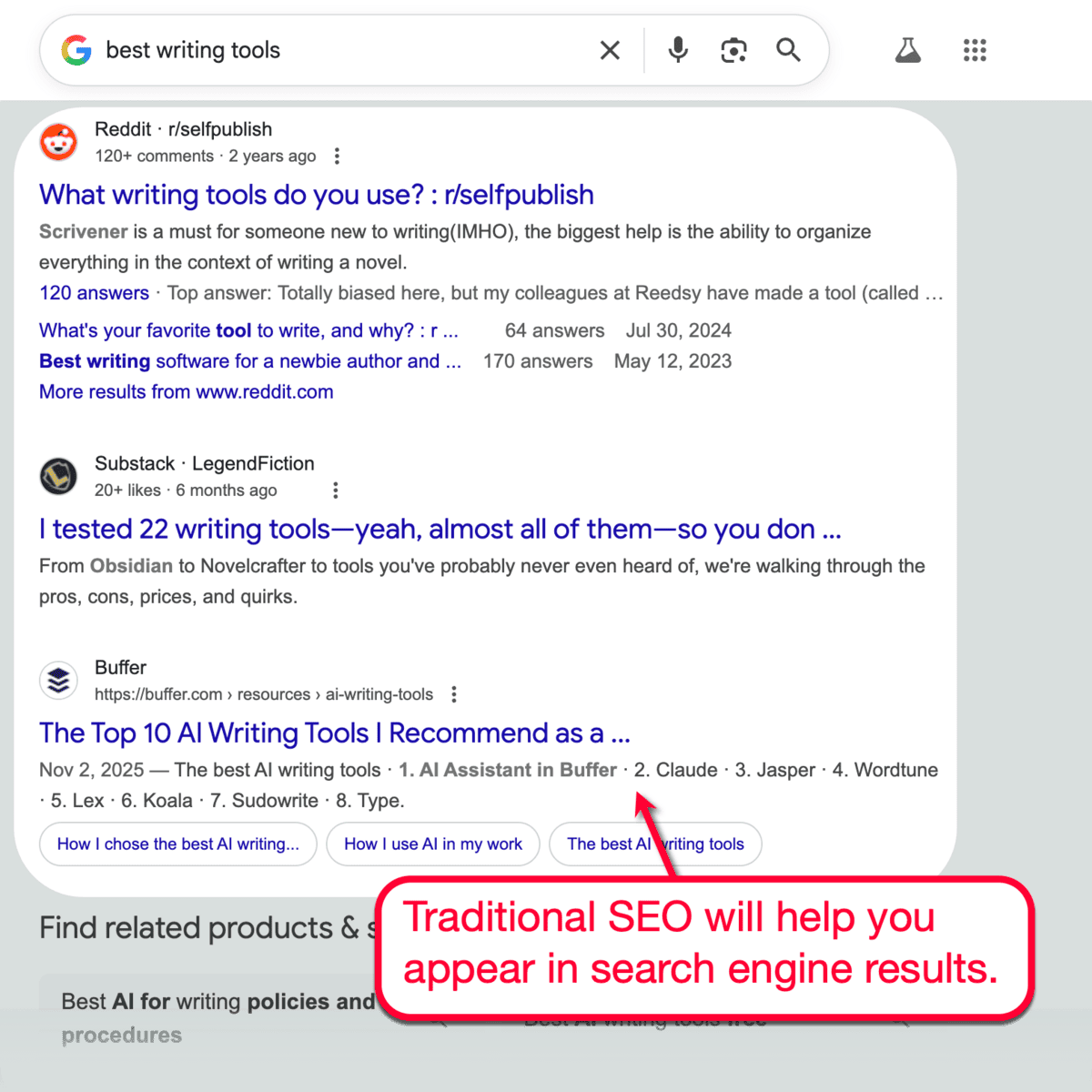
SEO involves time-consuming but dependable tactics that will boost your rankings in these results, such as:
- Link building
- Keyword research and optimization
- Competitor analysis
- Content marketing
- On-page optimization
Simple, right?
Today, however, there are new players on the block.
Why Businesses and Marketers are Worried About AI Results?
If you phrase your search query like a question, suddenly the top results look different:
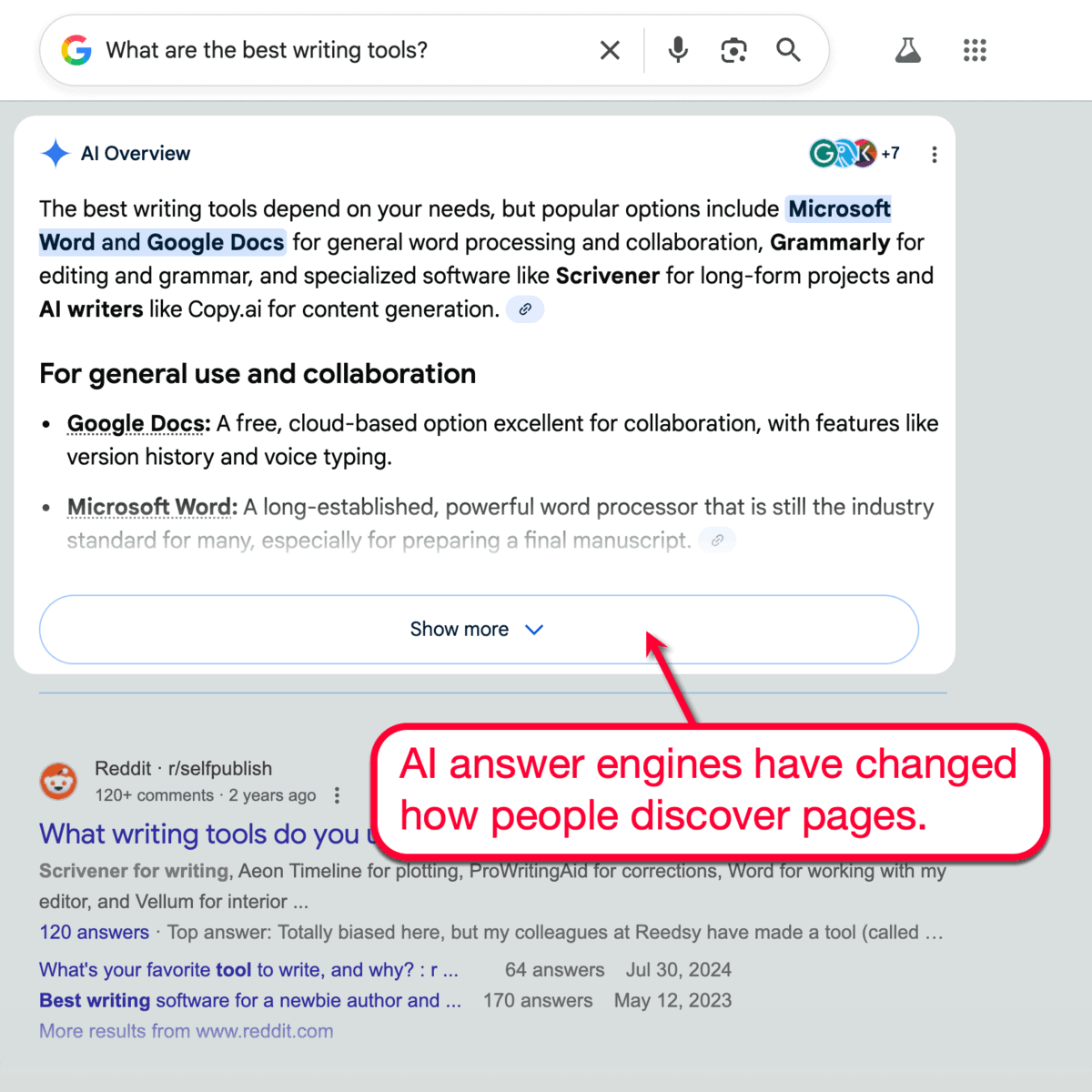
Statistics show that 13.14% of all search queries returned with AI-generated answers. It may not sound game-changing, but that’s actually up by 6.49% from just two months before the data was gathered.
Businesses are also worried about the fact that AI results can reduce clicks to organic listings by up to 34.5%.
We’re not even factoring in users who head straight to AI tools like ChatGPT, Grok, and Perplexity to conduct their online research.
This is where GEO comes in.
GEO is a collection of strategies aimed not only to increase your visibility in AI search results, but also to improve the sentiment surrounding your brand in AI-powered conversations.
What’s the Difference Between GEO and AEO?
Answer Engine Optimization (AEO) is another strategy similar to GEO that focuses on boosting AI visibility.
The main difference is that AEO focuses on AI responses directly on SERPs, like the AI Overview, voice responses, and other featured snippets. GEO, on the other hand, affects your visibility in tools for longer and more in-depth AI conversations, like ChatGPT, Perplexity, and Grok.
On the flip side, GEO and AEO have plenty of overlaps when it comes to the strategies and tools you’ll need. In fact, all GEO, AEO, and SEO can be incorporated into one overarching strategy.
This leads us to the next point:
Cracking the Code: How to Rank on Google and AI Search
The good news is, optimizing for both search engines and generative AI search tools doesn’t require a complex master plan that involves hundreds of hours of research.
I also managed to snag a couple of placements in generative results after exploring a few AI tools.

Let’s crack this open step by step:
1. Starting with a Solid Foundation
Action Plan:
- Find highly profitable keywords relevant to your brand.
- Identify the topics and prompts in AI conversations that lead to brand mentions.
- Set up an automated tracker to keep you up-to-date.
Here’s a key difference between SEO and GEO:
With SEO, you’re optimizing for keywords that people use when searching online. But with GEO, you’re optimizing for prompts and questions directed at AI.
You can set up the foundation for both areas with a single tool.
Semrush One combines two powerful toolkits that will benefit your SEO, GEO, and AEO. It can help you identify and optimize for the keywords and AI queries that can bring high-quality leads straight to your business.
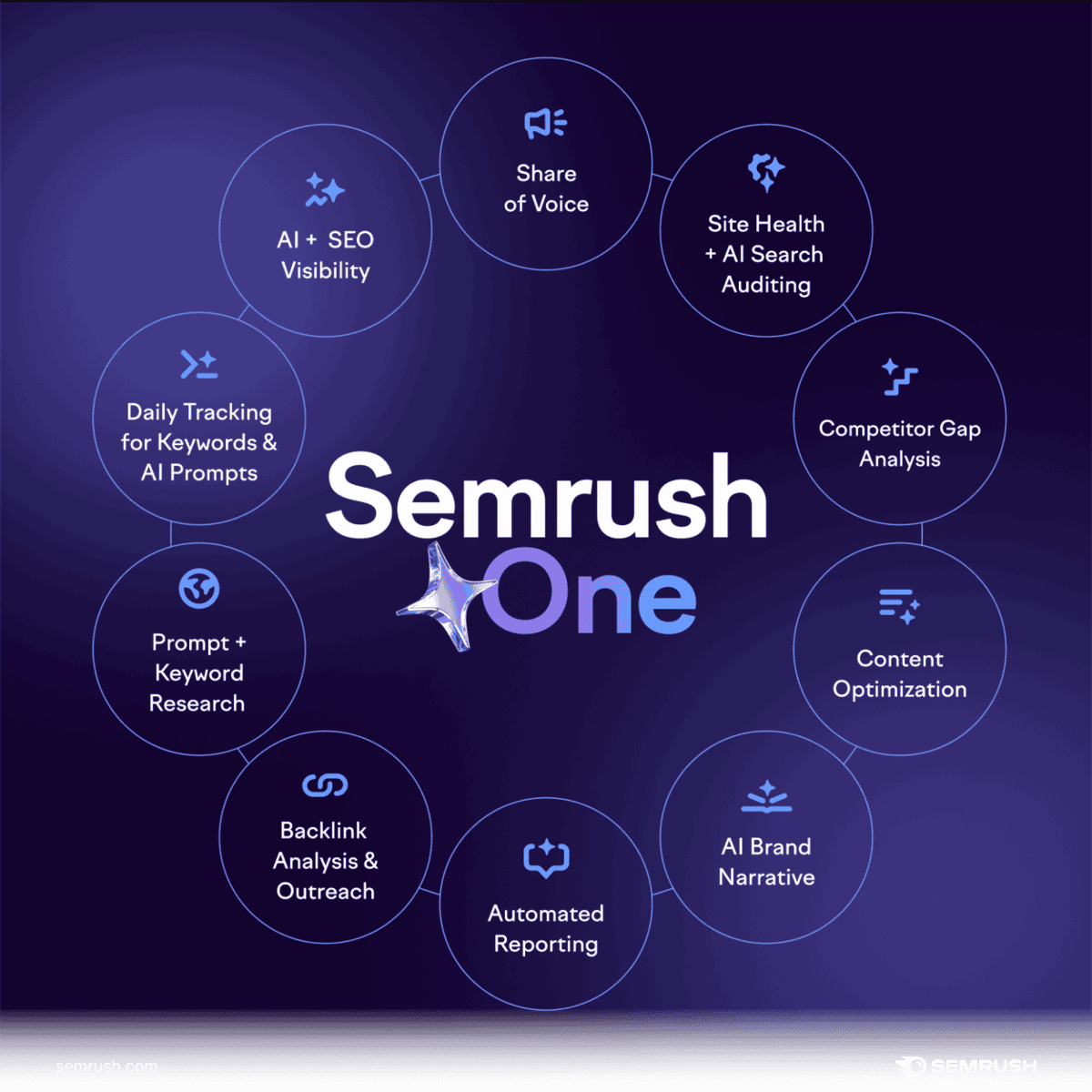
For keywords, my go-to strategy is to use Keyword Magic Tool to find long-tail keywords with high purchase intent.
Let’s say you’re in charge of marketing Grammarly — a SaaS business that targets professional writers and students.
On Keyword Magic Tool, start by entering a seed keyword that’s relevant to your business (think of something your target audience would search for).

Optional: You can enter your official business domain to get keyword results tailored to your online marketing needs.
Within seconds, Keyword Magic Tool will give you a list of feasible keyword suggestions that can guide your SEO strategy moving forward.

Pay attention to the included metrics when building up your target keyword portfolio.
A high search volume, of course, means more people are searching for that topic online. But make sure the Keyword Difficulty (KD) rating is within a reasonable range, which should be under 50 if you want quick results (up to 69 if you have an adequate budget for link building).
Learn more about advanced keyword research tactics, including competitor keyword analysis, by reading my guide here.
Switching over to GEO, for online businesses like SaaS and service providers, the first step is to look for existing AI mentions. This will help you identify prompts, questions, and other AI queries that put your brand into conversations.
Semrush One can reveal the information you need. Just get the ball rolling by plugging your domain into the Visibility Tracker tool.

Take note that the Semrush AI Visibility Toolkit consolidates reports on both generative and AI answer engines. That means you’ll find useful insights for GEO and AEO in the same place.
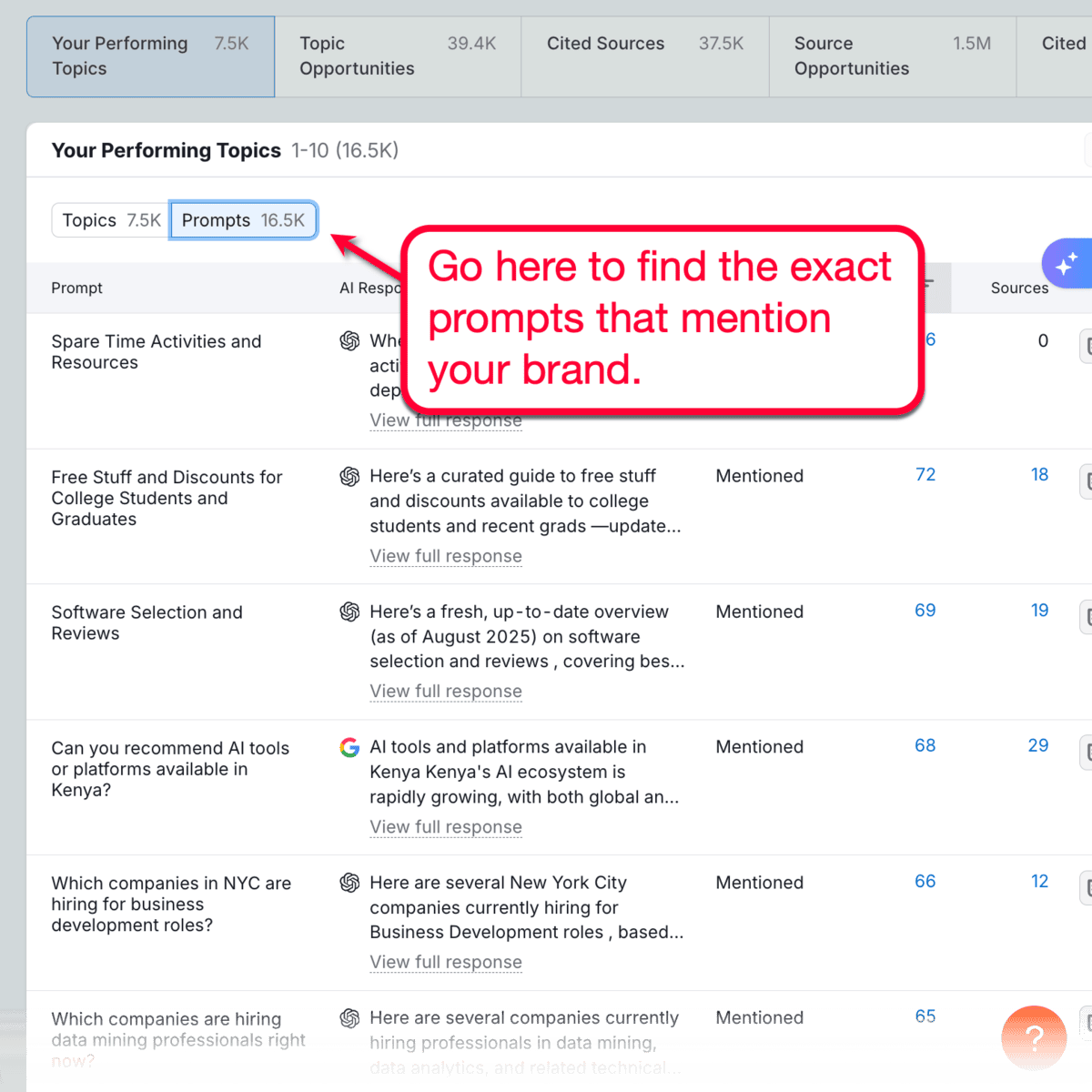
To find the AI prompts and topics that lead to your brand, scroll down to “Topics & Sources.”

For the full context behind AI mentions, switch to the ‘Prompts’ tab. This reveals the exact prompts that users enter when using AI tools.
Pro Tip: After tracking your AI topics and prompts, I highly suggest setting up the prompt tracking feature to keep you updated on all changes regarding your AI optimization efforts.

For this, you need to create a new project, enter your domain, specify your location, and select the search or AI engine you want to track.

Next, just enter the keywords or prompts you want to track and click ‘Start Tracking.’ And unless otherwise necessary, keep weekly ranking updates enabled to stay ahead of the curve.
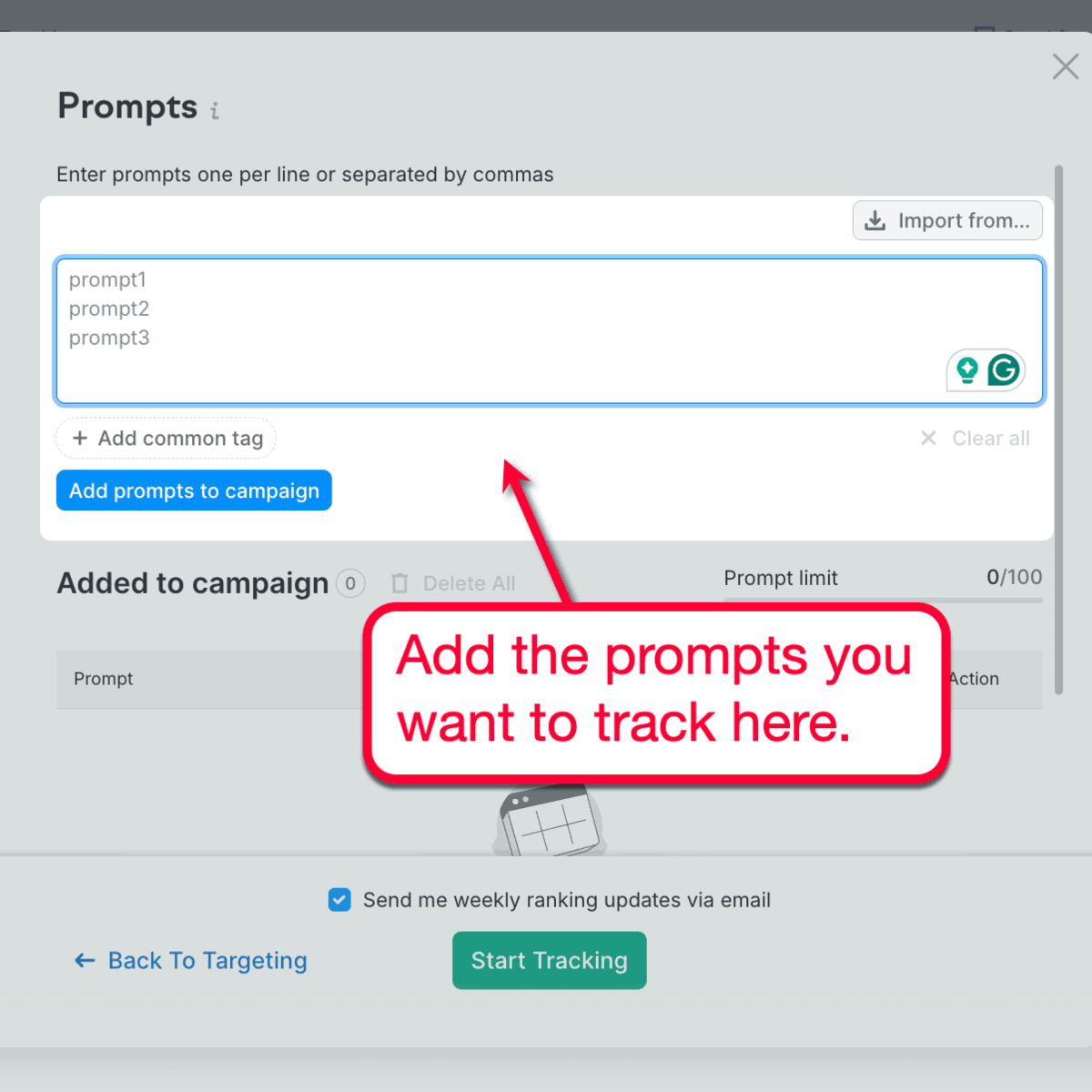
Straightening out your SEO keyword and GEO prompt strategies will position your online brand for continuous growth.
The next order of business is to sort out other aspects of your website that impact online visibility.
2. Preparing Smarter Content for SEO and GEO
Action Plan:
- Run a site audit for a comprehensive sweep of your website’s SEO and GEO health.
- Address technical optimization gaps to ensure your website’s rank-worthiness.
- Build smarter content that directly answers user questions.
Through the years, businesses have known that SEO and content marketing go hand in hand.
With the arrival of GEO and AEO, you can picture all of them as a group of close friends — elbows locked and empowering businesses to achieve online greatness.
I’d start with a thorough website audit to identify weaknesses in terms of content and technical optimization.
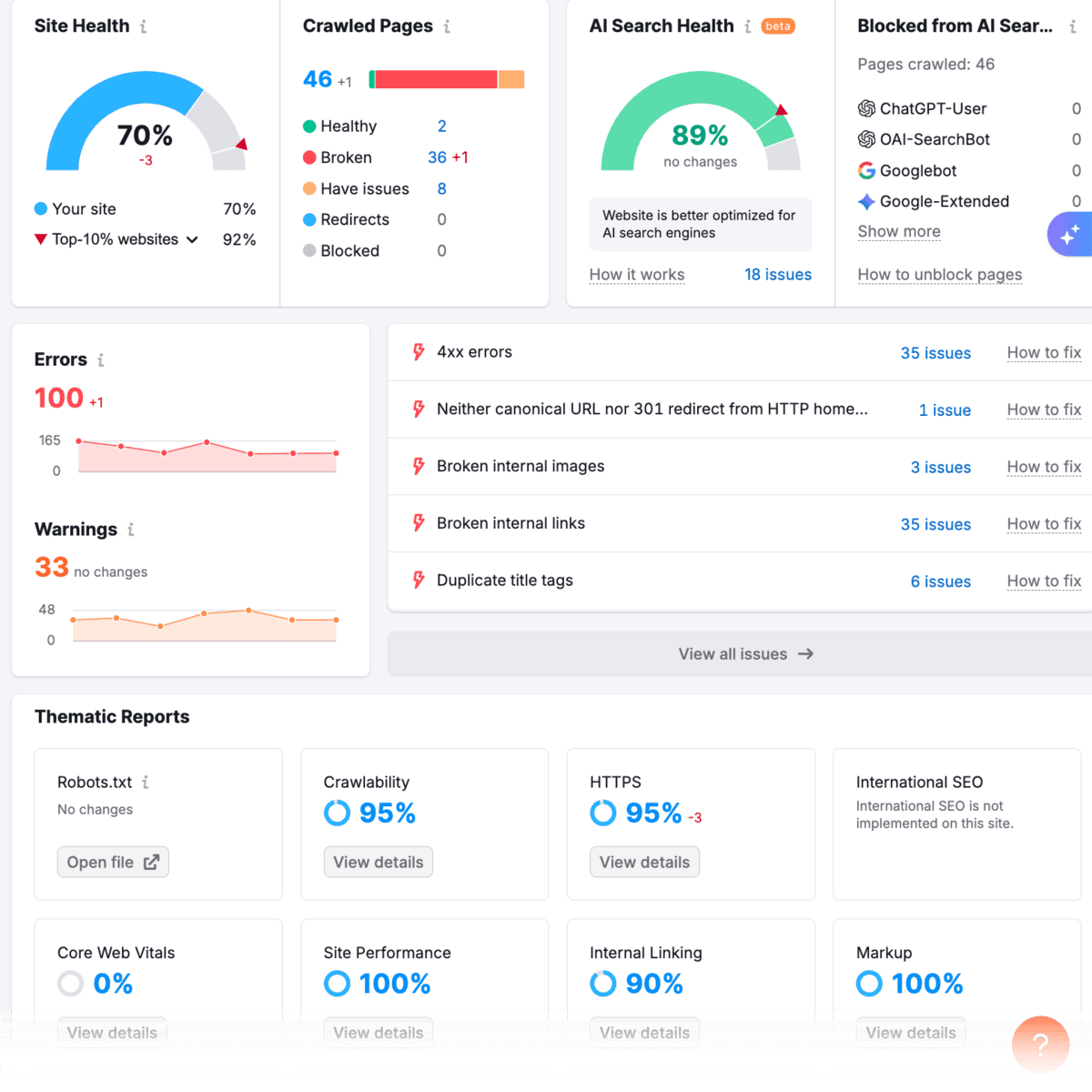
With Semrush One, you gain access to the Site Audit tool. This scans your website and reveals everything there is to know about your SEO and GEO.
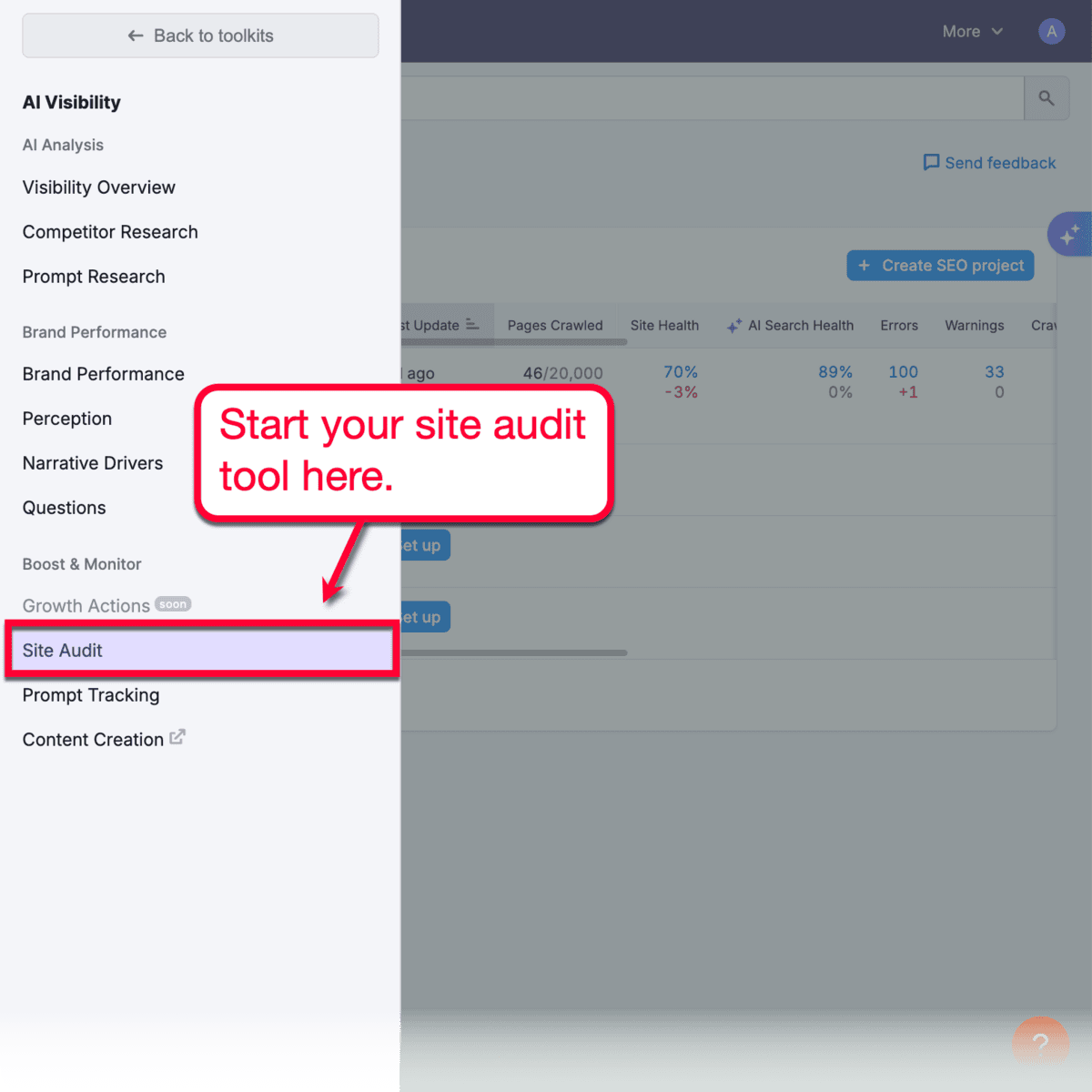
Once the audit is completed, the report kicks off with an overview of high-level metrics, like the status of crawled pages (e.g., “healthy,” “broken,” or “have issues”), site performance rating, and overall site health score.
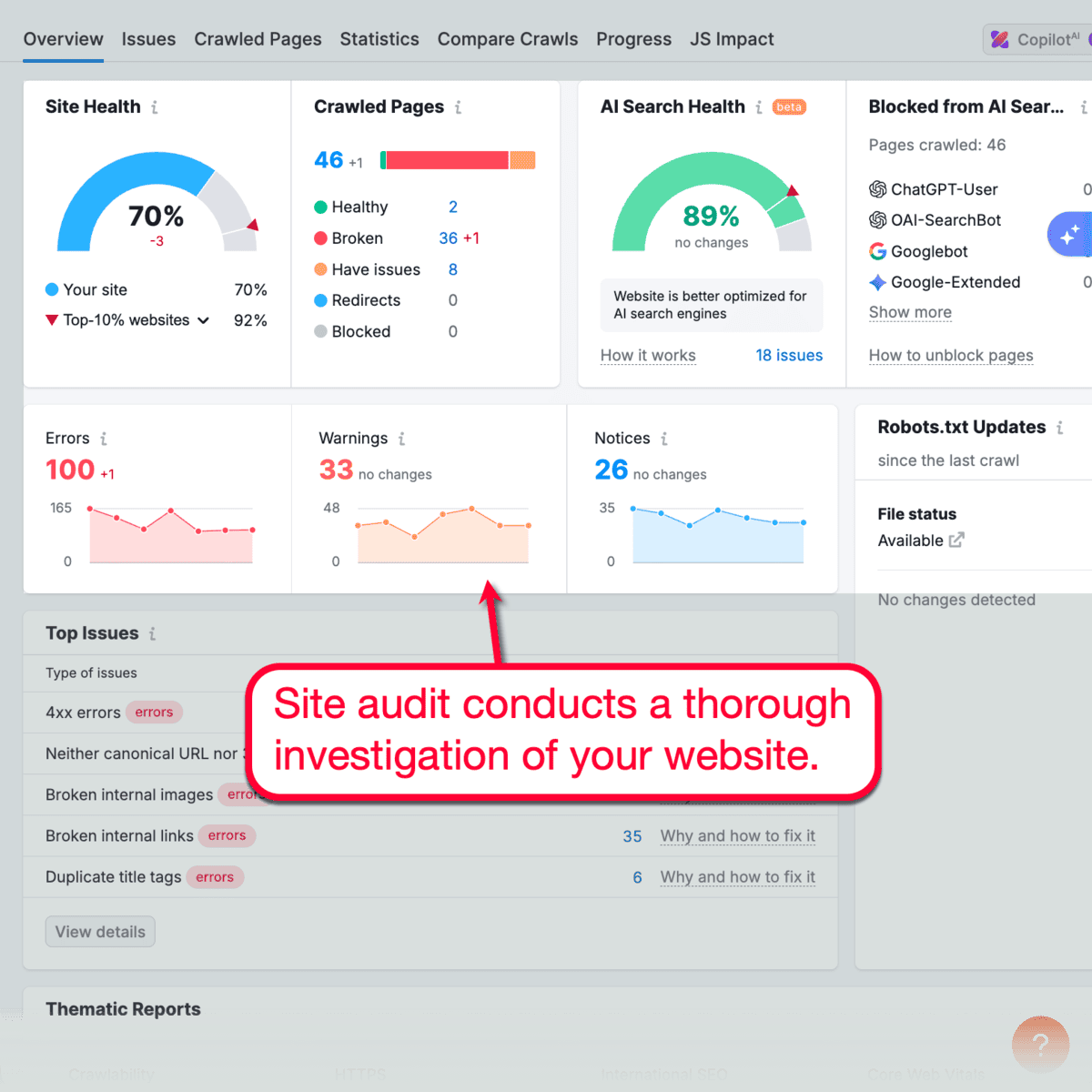
While these metrics are useful in tracking progress, the real gold lies inside the ‘Issues’ tab. Here, you’ll find actionable insights on issues affecting your website’s AI search visibility, crawlability, content optimization, and more.

Want to find out more about the problem and how to address it?
Click on any of the listed issues to reveal more context as well as the necessary fix. You might be surprised at how easy it is to fix most issues related to generative AI SEO.

Here’s the thing: A lot of on-page SEO and GEO issues have something to do with your content. This includes broken links, a lack of internal links, missing H1 tags, and pages with low word counts.
For good measure, here’s a quick rundown of technical content optimization strategies that worked for me through the years:
- Make sure all in-post links are working.
- Avoid duplicate content and elements (i.e., duplicate title tags).
- Use descriptive meta descriptions for images.
- Aim for a text-HTML ratio of 90:10 (90% of the page should be visible content).
- Only use descriptive anchor texts when adding links.
- Avoid publishing thin content by making sure every page has at least 200 words.
Just remember that addressing these issues is just the beginning. Whatever optimization tactic you learn from your site audit, you need to incorporate it into your long-term website content strategy — that’s how you make smarter content.
Pro Tip: Consider tools like Semrush’s SEO Writing Assistant for real-time optimization suggestions for your drafts. Just paste your text or import your post via its URL, enter your keywords, click ‘Get recommendations,’ and let the tool do the rest.

3. Off-Page Tactics for SEO and GEO
Action Plan:
- Identify backlinks and context sources that AI trusts.
- Start building high-quality backlinks through content-driven strategies.
- Earn links naturally by publishing link magnets.
The saying “build it and they will come” doesn’t work in content marketing and SEO, let alone GEO and AEO.
You need an outward approach to get your brand out there, build your authority, and get in the lens of AI engines. And to make this process as effective and efficient as possible, you have to target the right sources.
First, use Semrush’s AI Competitor Research tool to identify the trusted sources Large Language Models (LLMs) use to collect information. From the AI Visibility Toolkit, go to ‘Competitor Research’ and enter your domain.

After waiting for the report, scroll straight down to the “Topics & Prompts” section and choose something you’d like to prioritize. This will pull up the specific prompts and AI responses that generated mentions of you or your competitors.
More importantly, it can show you links to publications, blog articles, and other information sources that the AI engine trusts. In other words, these are the targets you should focus on when building links or citations.

Since you’re trying to build your authority, you should focus on sources that mention your competitors — but you don’t.
To find these sources, simply switch to the ‘Missing’ tab and look for a potentially lucrative topic or prompt that your brand probably hasn’t targeted before.
Imagine you’re the marketing manager at Grammarly and are looking for new topics that bring visibility to a top competitor. Using the AI Competitor Research tool, you’ll discover topics like “online language translation tools,” which could expose your brand to more AI users.
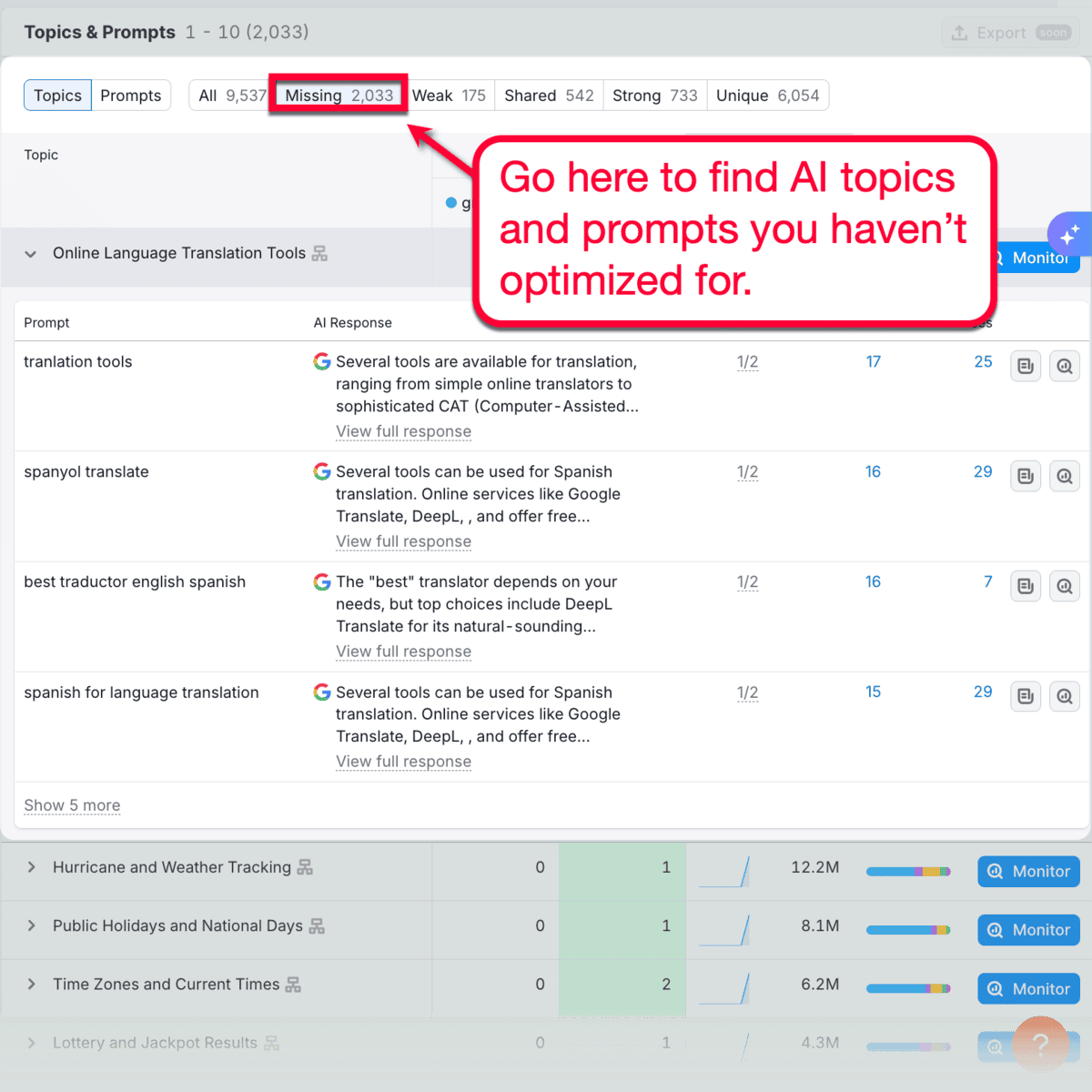
What you need to do now is to look at the information sources used in these AI conversations and target them in your link-building campaign.
This is an entirely different arena, but my go-to, three-step approach is as follows:
- Find AI information sources that accept guest posts.
- Learn their guest posting guidelines and pitch a topic.
- Write an awesome post and add your own backlink.
For a more complete list of link-building strategies, refer to my guide here.
Lastly, you can passively land backlinks by creating and publishing link magnets. These are pieces of content that are so good, other bloggers, website owners, and online creators can’t help but share with their own audience.
Some examples are:
- Original case studies
- Data visualizations and infographics
- Quotes (compile them into roundups)
- Free eBooks
- Online courses
- Slideshows
Now, it may take some time for link magnets to get results. But once they’re published and you’ve done your part in promoting them, they’ll work overtime to win you backlinks from other content creators.
4. Focus on Website Performance and Formatting
Action Plan:
- Run a website speed test to address performance-related issues.
- Make sure your website performs consistently between desktop and mobile devices.
- Use content formatting techniques that users, search bots, and AI crawlers can easily scan.
There’s one more thing SEO and GEO have in common:
Both factor in website performance when determining visibility or rankings.
While there are a ton of factors that can affect your website’s loading speed, you only need to worry about issues that specifically apply to you. And tools like PageSpeed Insights will lead you straight to them — just enter your domain and click ‘Analyze.’
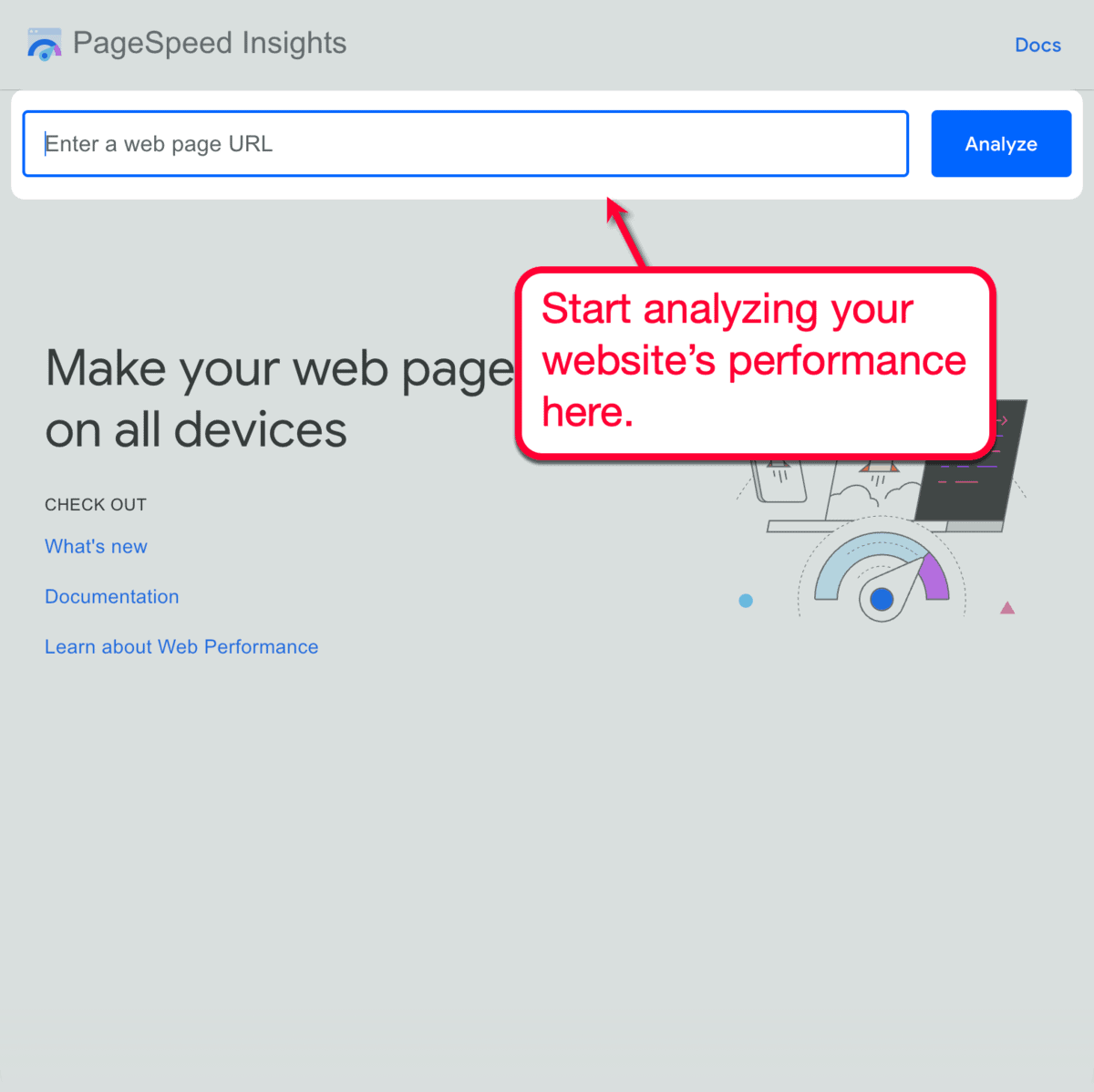
After the analysis, PageSpeed Insights starts off with an overview of your Core Web Vitals metrics, which are metrics that translate how website performance is reflected in real-world user experiences.
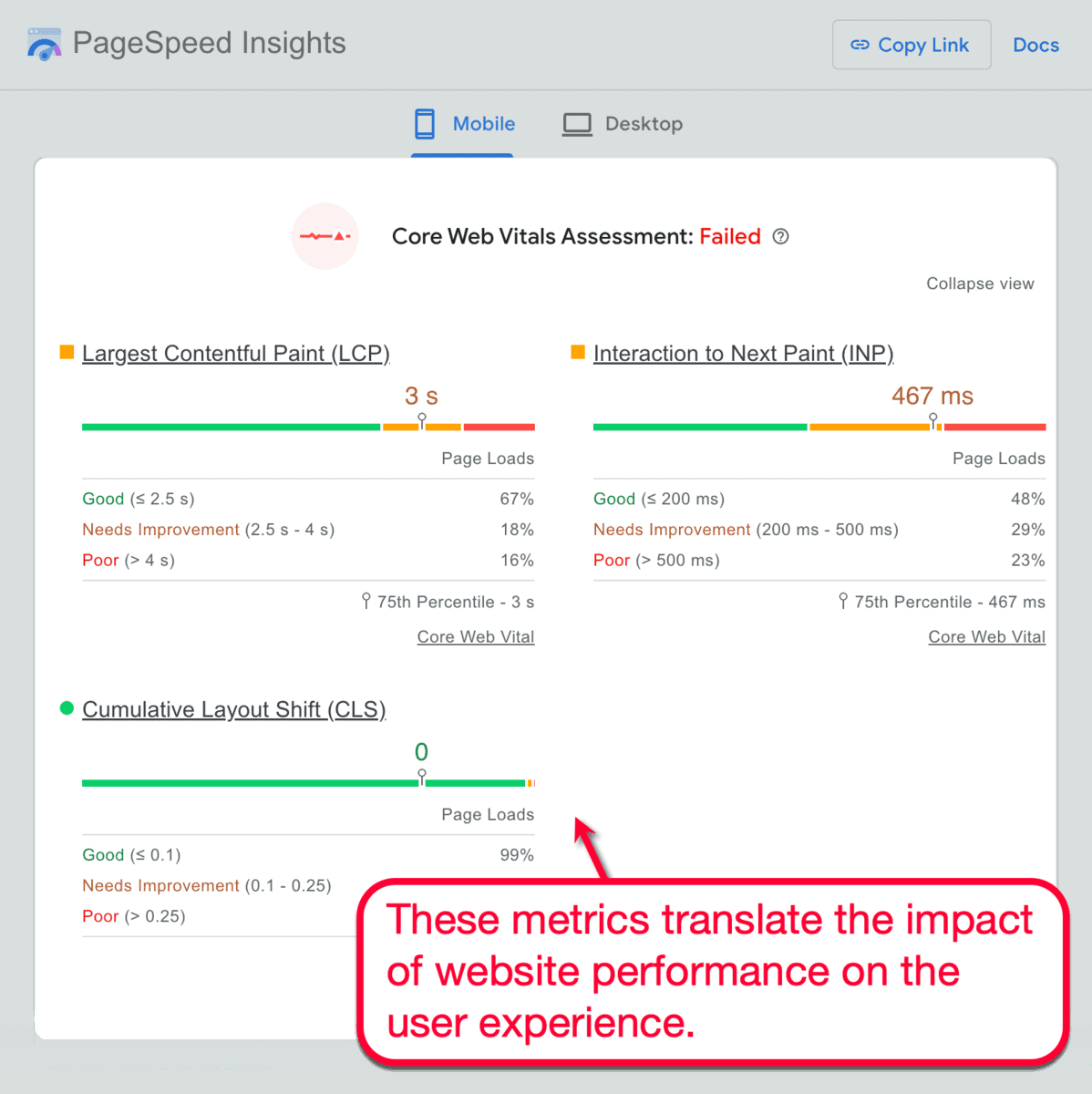
However, all the good stuff can be found under the “Insights” and “Diagnostics” sections. This is where you’ll find specific performance issues plaguing your website, as well as actionable recommendations for addressing them.

As a bonus, PageSpeed Insights can analyze your website’s performance on both mobile and desktop devices. This will help you provide a consistently smooth experience to all users.
To expedite your performance optimization efforts, here’s a list of the top performance optimization strategies you should look into:
- Optimize your images — Use tools like Kraken.io to compress images without reducing quality. Alternatively, upload your images using next-gen formats like WebP, which prioritizes speedy load times.
- Optimize your JavaScript and CSS — Minify your scripts with tools like Minifier to improve loading speed and prevent them from blocking other elements from rendering. You should also start being more aware of your code hygiene, which includes removing unused code that somehow still gets loaded.
- Invest in a Content Delivery Network (CDN) — A CDN is a network of proxy servers tasked to deliver cached website data to nearby users, effectively nullifying network latency. Some of the popular CDN service providers are Cloudflare, Amazon CloudFront, and Akamai.
Apart from performance, improving your content’s structure also helps maximize your SEO and GEO results.
A crucial strategy is to create content that directly answers user questions. This can be done within your content’s main body or by creating a separate Frequently Asked Questions (FAQs) section.
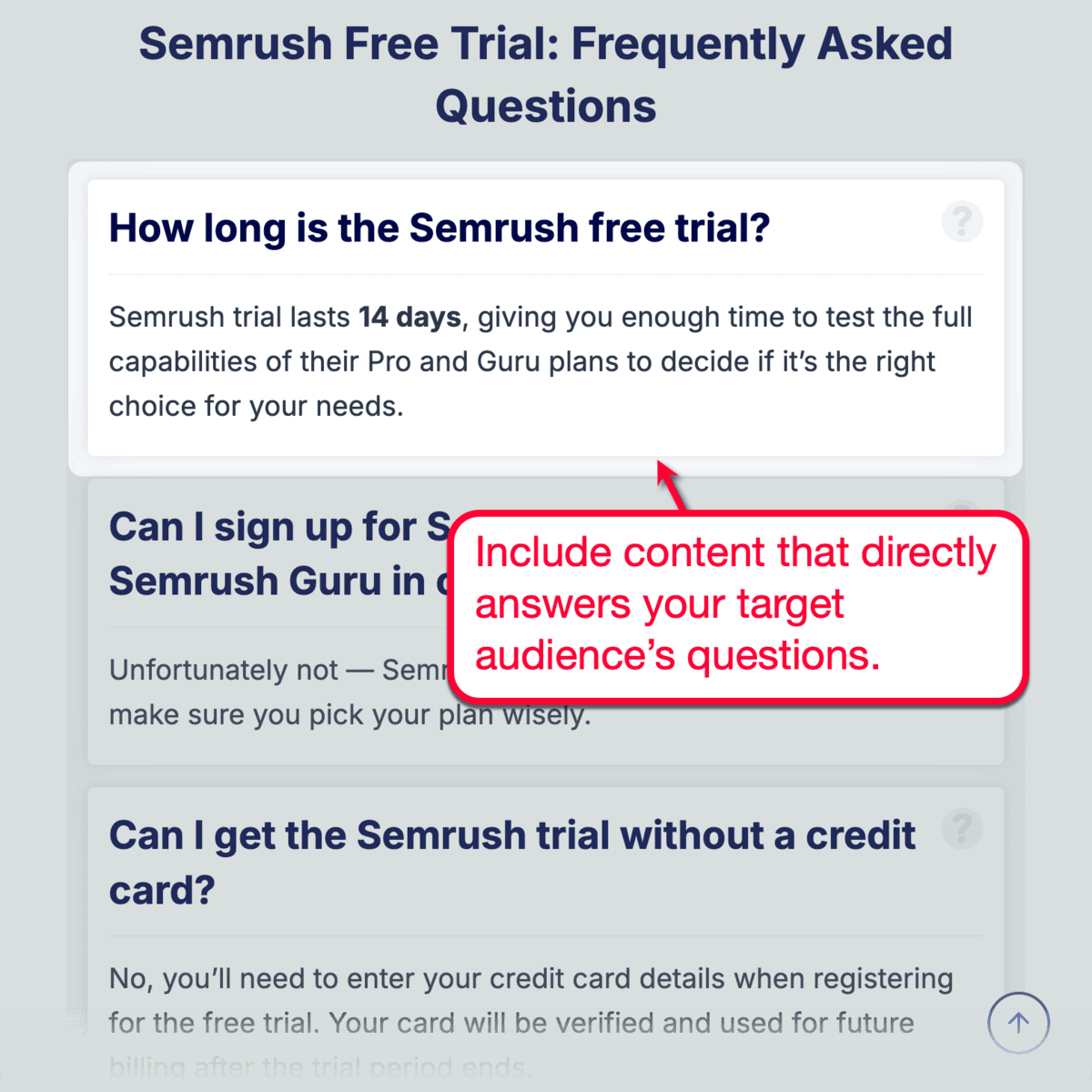
It’s a simple but powerful strategy that will help your content get picked up in featured snippets, AI answers, and generative conversations.
5. Monitor Results and Make Adjustments
Action Plan:
- Set up performance tracking and AI analytics tools.
- Adjust and optimize your strategies based on results.
- Explore growth opportunities over time.
Finally, remember that nothing in SEO and GEO is guaranteed.
You can’t concoct the perfect blueprint in one sitting. But, you can improve your strategy over time — and data will be your map to growth.
Utilizing a prompt tracker is a step in the right direction. And once you run a site audit with Semrush One, the tool will continuously track for changes around important metrics and thematic reports.
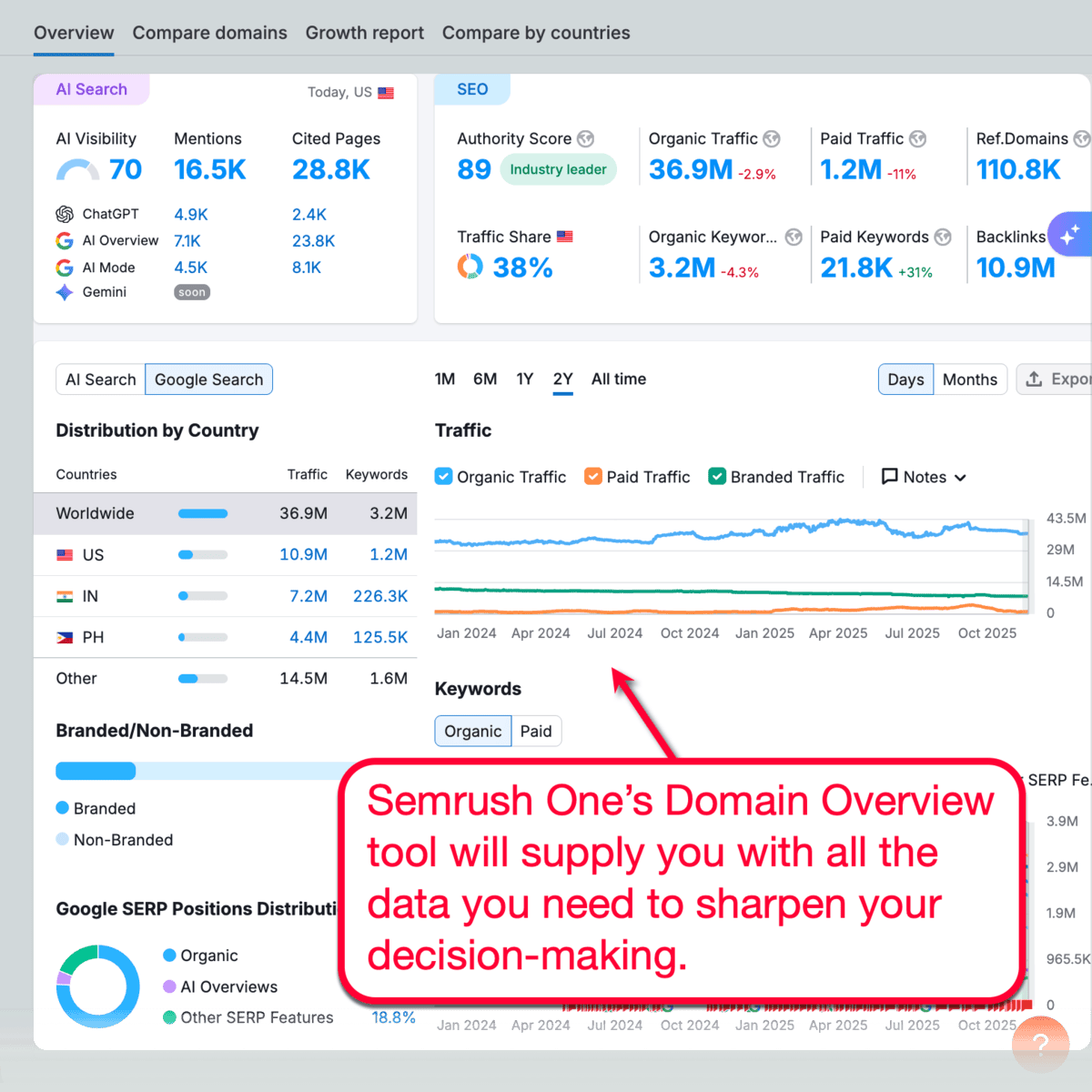
You should also conduct daily, on-demand performance checks to monitor metrics like:
- Organic traffic
- Paid traffic
- Backlinks
- AI brand mentions
- Keyword rankings
Semrush One’s Domain Overview tool will help you keep a watchful eye on these metrics and more.
Here’s one last parting tip:
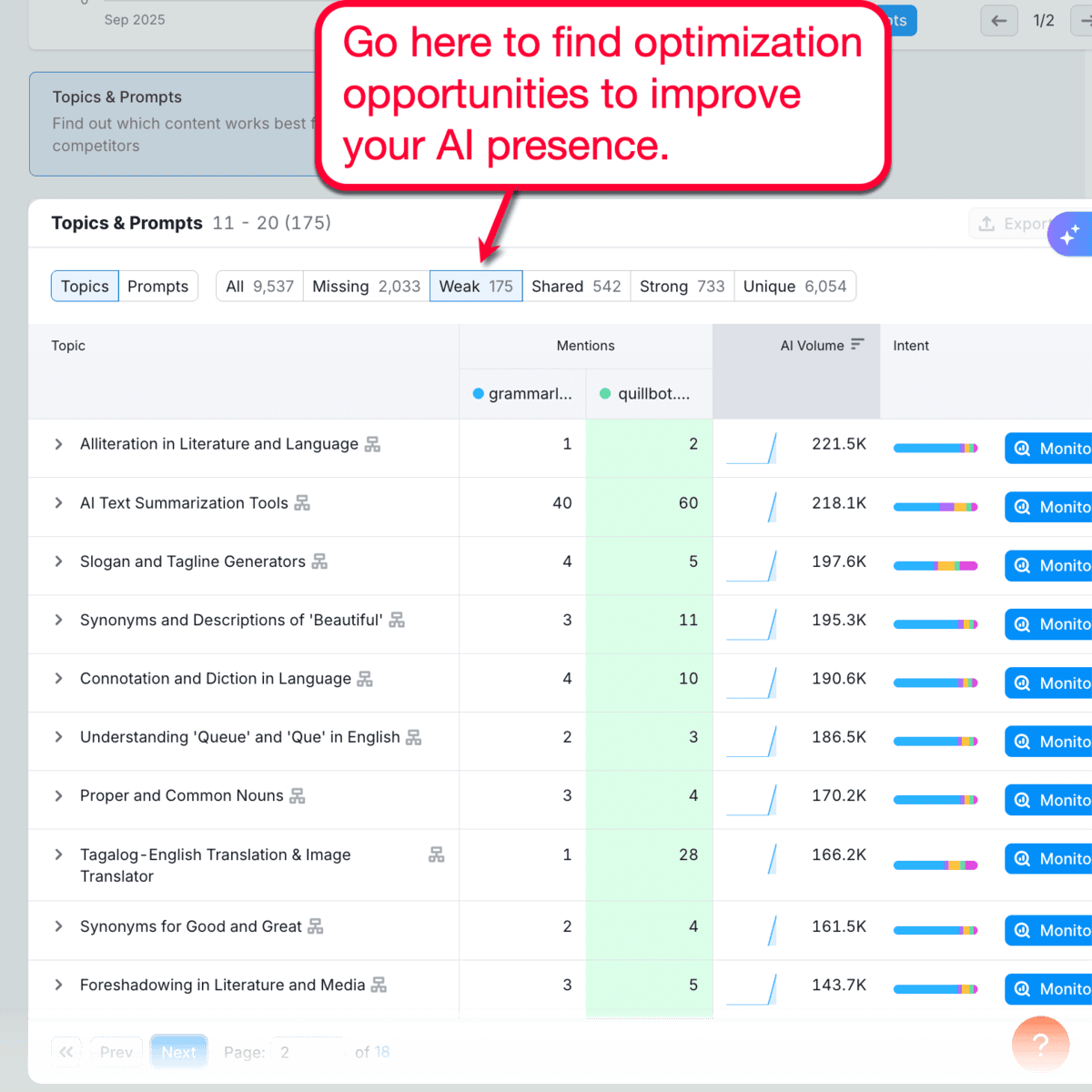
Using the AI Competitor Research tool, you can easily find growth opportunities that can take your GEO to the next level.
Apart from AI topics and prompts that you have no presence in (“Missing“), you can also target topics and prompts in the ‘Weak’ tab where competitors are beating you — these are the obvious optimization targets that will accelerate your growth.
Your Next Steps
- Start your Semrush One free trial – Activate the 14-day access to test every SEO and AI visibility feature in real conditions.
- Check your current visibility – Run the AI Visibility Overview to see how often your brand appears in search and AI answers, along with the queries where competitors outrank you.
- Find keywords with dual ranking potential – Use Keyword Research to locate terms that show both search listings and AI answers. These give you the fastest path to real impact.
- Map your content for AI and SEO – Build topic clusters around your product and highlight pages that can win in both ranking systems.
- Track progress and refine your strategy – Monitor movements in search, track your AI answer presence, and let the platform guide your next opportunities.
Semrush One gives you a unified path to grow in both SEO and AI search. Begin your free trial and move forward with a strategy designed for the new search environment.

Article by
Ankit Singla is the founder of Master Blogging. With over 15 years of blogging experience, he helps entrepreneurs build blogs that become long-term business assets through content, SEO, and authority.
