
Competitor Website Traffic: How to Check and Interpret It

Competitor traffic analysis exists to improve ROI, not to inflate vanity metrics.
Many businesses fixate on traffic sources and surface-level numbers, assuming more visits automatically mean more growth.
In reality, traffic without context leads to wasted spend, misaligned content, and poor strategic decisions.
That’s why I evaluate competitor SEO and AI visibility together. Not to copy traffic numbers, but to understand which visibility actually translates into revenue and which doesn’t.
Why I Personally Analyze Traffic Using Search + AI Together
For a long time, I only looked at search traffic.
That worked until it didn’t.
Organic search traffic shows what wins on Google. On the other hand, AI answers reveal what’s “authoritative” and “trustworthy” in your space.
Once AI answers started influencing my clicks and brand discovery, search data alone felt incomplete.
Remember, any AI-generated article that’s structured precisely for Googlebots can rank.
But brands that are recommended or cited by AI overviews and chatbots win more trust.

Data indicates that AI users are 4.4 times more valuable (based on conversion rate) than search users. That’s because AI conversations equip them with more refined information, accelerating their research and purchase decisions.
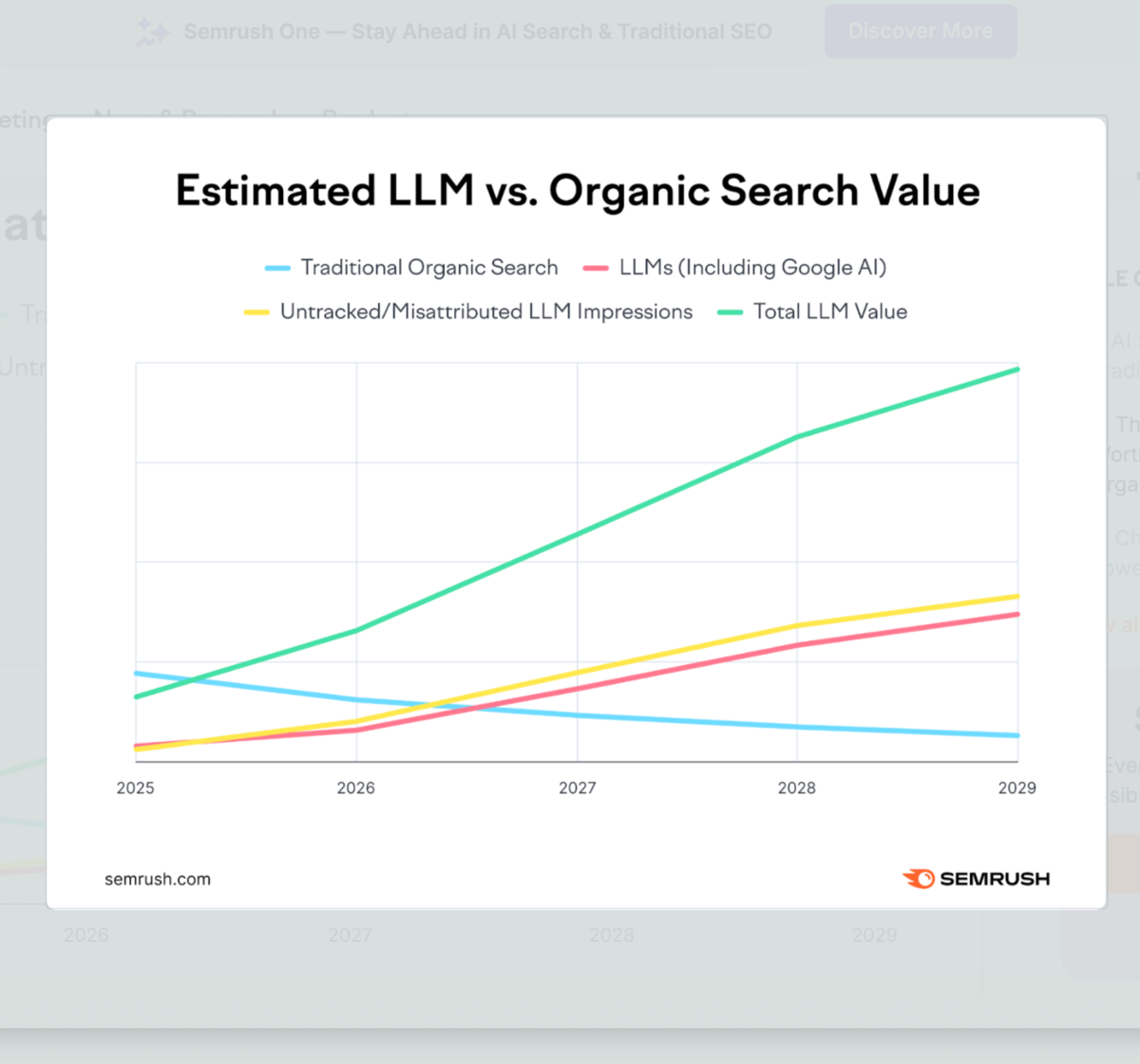
Don’t get me wrong — there was a time when I only looked at search traffic when conducting competitor research.
Now, I look at both search traffic and AI visibility together because separating them gives a distorted picture.
This ensures my research covers the complete, modern customer experience on the web.
Why Search Traffic Alone No Longer Tells the Full Story
For several years, I’ve considered SEO as the endgame for any brand.
After all, the majority of online experiences used to start with a quick Google search.
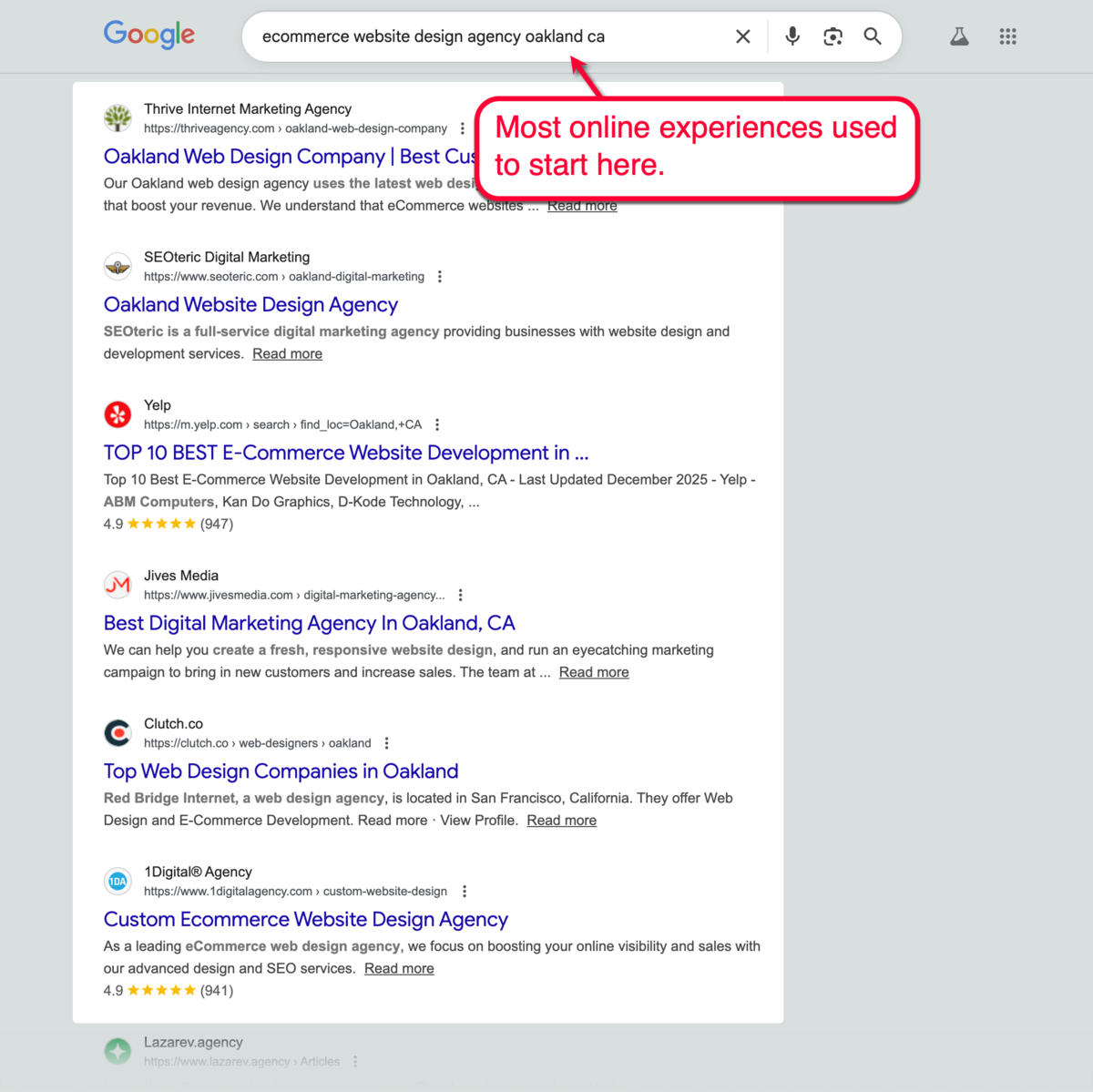
But during the breakthrough emergence of Large Language Models (LLMs) and AI chatbots, I saw a paradigm shift.

I’ve seen competitors with unremarkable SEO rankings show up consistently in AI answers. At the same time, there were sites with strong SEO presence that got completely ignored by AI.
If you only look at SEO traffic, you miss where authority is actually being assigned.
The bottom line is simple: User attention and information discovery online have changed.
As such, traditional SEO research methods (i.e., basic competitor keyword analysis) have gaping blind spots.
This causes marketers and businesses to miss out on opportunities to build online authority and visibility.
I remember when it happened to me, and I don’t want it to happen to you.
How I Check a Competitor’s SEO Traffic (Search)
This is how I personally check a competitor’s SEO traffic.
I use the SEO Toolkit from Semrush One to estimate my competitor’s average monthly traffic.
This helps evaluate their SEO presence.
At the same time identifying potential keywords and similar competitors that broaden my research.

Overall, these details help me pinpoint where the demand is going.
I then identify the specific pages or posts that drive the most visits. This tells me what topics are actually converting attention into traffic.
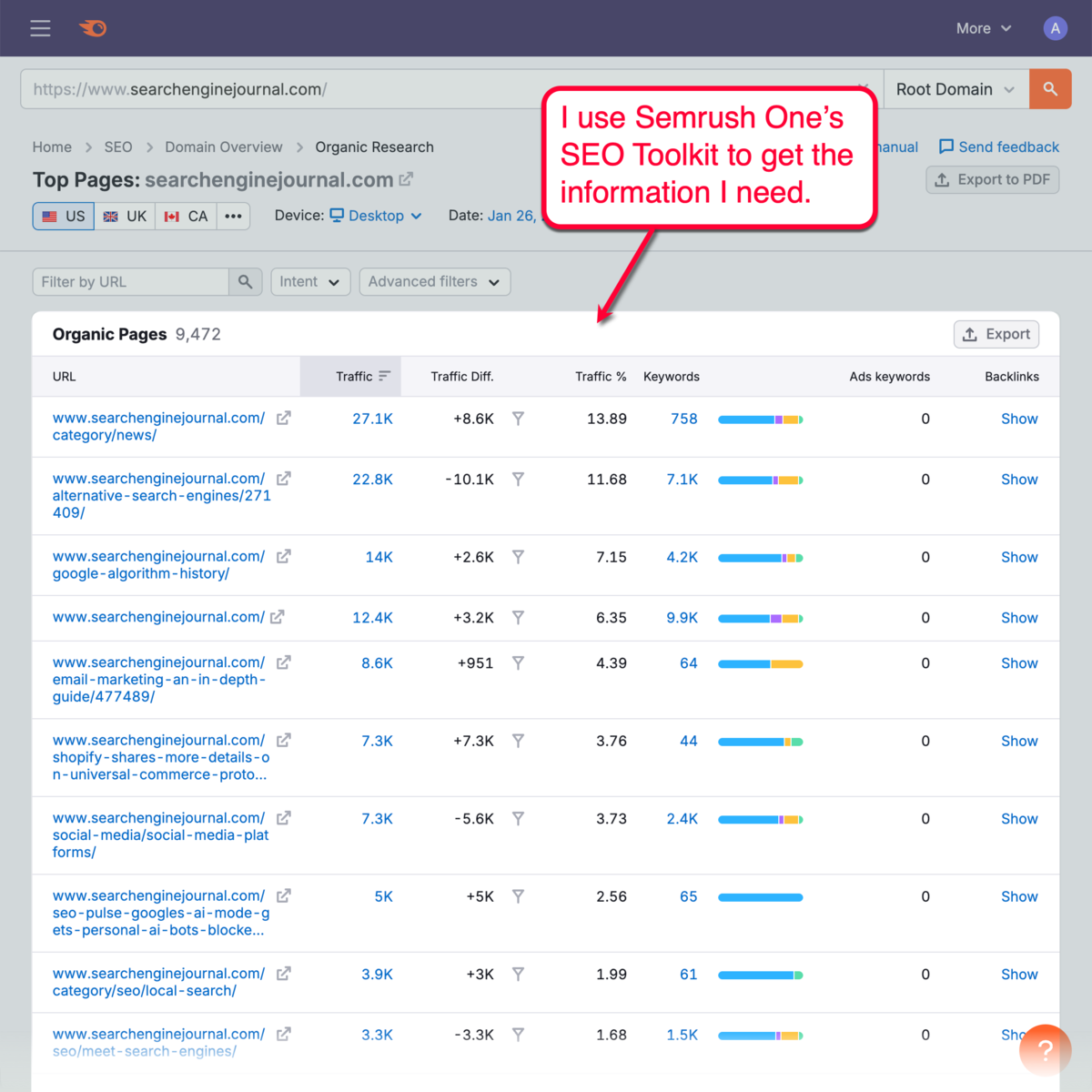
I don’t obsess over exact traffic numbers. I care about which pages consistently pull in visits.
Similar SEO tools, like Ahrefs and Mangools, work as well. The only requirement is a competitor analysis tool or feature.
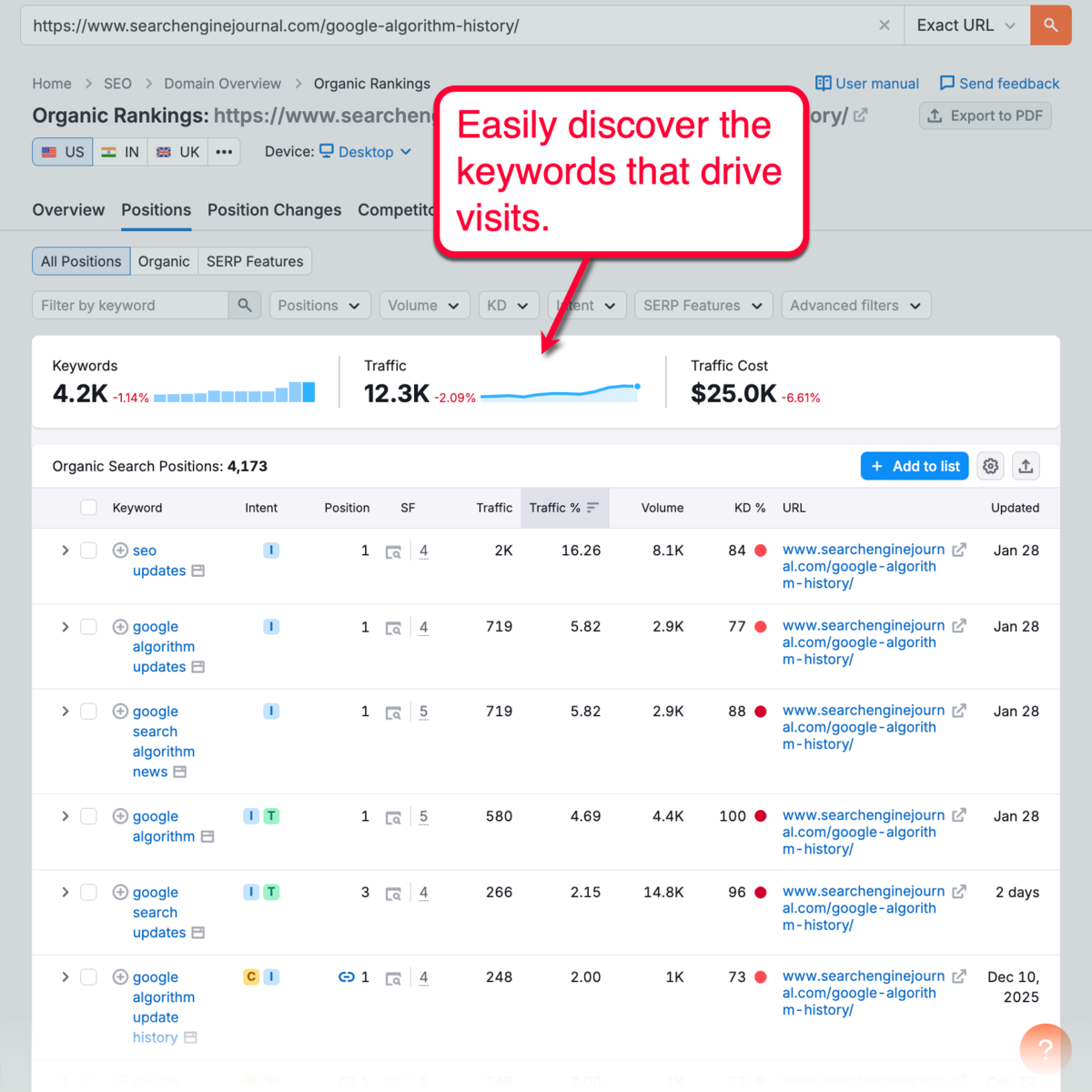
That said, I also analyze their top pages to reveal SEO factors like secondary keywords, word count, Call-to-Action (CTA) placements, and overall language.
This is one of the advantages I love about Semrush. It’s easy to hop between analyzing pages and uncovering SEO keywords that drive demand and attention.
How I Check a Competitor’s AI-Driven Traffic
This is the part that most people overlook — and I used to skip it, too.
Apart from their organic search presence, I also investigate my competitors’ visibility in AI-driven conversations.
This includes how often their brand appears in AI responses, which prompts lead to mentions, and which pages are referred to.
I use Semrush One‘s AI Visibility Toolkit since it consolidates all the information I need in one place.
For starters, it allows me to look into how many times their brand was mentioned and which of their pages are cited in AI conversations.

I also look at which exact prompts and topics lead to these mentions. This is where I get the juicy, actionable opportunities from my AI competitor research.
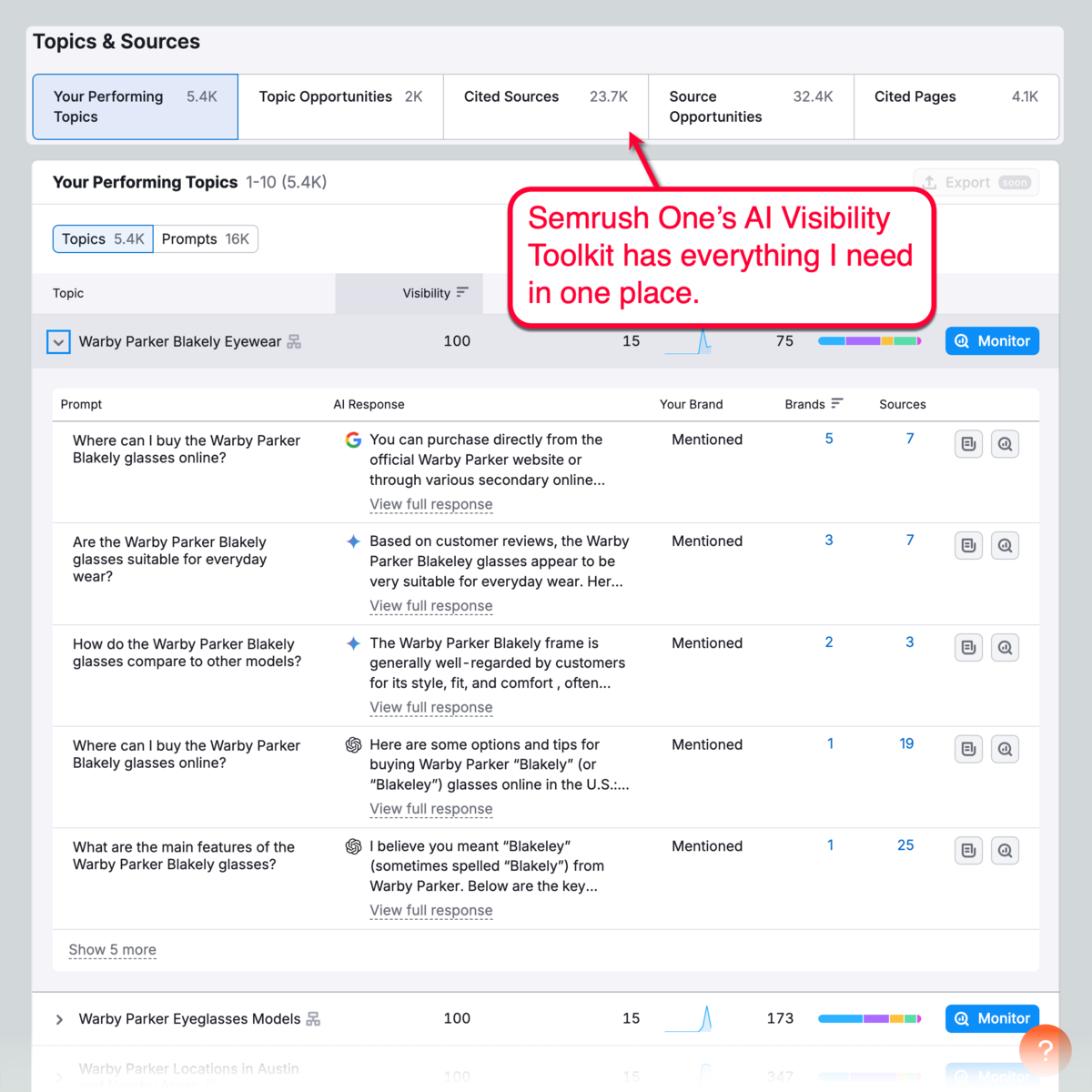
Keep in mind that I’m not looking at keyword data here. This shows where AI systems are assigning trust and sending attention.
How I Combine Search and AI Data to See the Full Picture
In a nutshell, my competitor research mindset is built on two foundational pillars:
Search traffic shows demand capture. AI visibility shows authority capture.
Search traffic shows the competitor’s reach.
AI visibility, on the other hand, indicates dominating authority.
With these in mind, I actively search for patterns that influence my decision-making.
For example, when a competitor shows a strong AI presence but weak SEO, content depth usually matters more than volume. But if it’s the other way around (strong SEO and weak AI), there’s more emphasis on keyword optimization and content that sufficiently addresses a specific user intent — without going in too deep.
When both are strong, that’s where I’m willing to compete.

They’re capturing demand through high-intent clicks in organic search while building the topical authority for long-term brand resilience.
Armed with this information, I’m ready and eager to dive in.
What I Do After Analyzing a Competitor’s Traffic
Competitor SEO and AI visibility data answer three things:
- What topics are worth competing for? This analysis tells me where to invest effort and where not to waste it. I get the best results by prioritizing topics that generate visibility in both organic search and AI systems.
- What formats should I prioritize? Every competitor’s SEO and AI visibility data leaves a breadcrumb trail to the actual page or post that drives results. I follow this trail to understand what formats perform well in those topics.
- What should I avoid entirely? I prefer looking at opportunities that not only bring short-term traffic, but also long-term, scalable Return on Investment (ROI). If my top competitors don’t care about their search engine or AI presence in a particular topic, that’s a clear sign saying “avoid at all costs.”
Guide your competitor research and decision-making using both search and AI visibility signals — as well as a clear understanding of who your customers are.
In some cases, I decide not to compete at all.
This saves months of execution by preventing the wrong bets.
For example, even if a competitor generates decent traffic for a particular topic, it may still not be a good bet if the AI responses only cite non-competitors (e.g., government sites or Reddit).
That means potential leads aren’t sent to competitors, anyway.
But if the topic attracts visitors with high purchase intent and promotes brand authority through favorable AI mentions, that’s a green light for me.
Why I Personally Use Semrush One for This Workflow
Competitor SEO and AI visibility analysis can be done by other tools.
I could stitch together multiple tools, but that slows my decision-making.
Remember, wasted time is lost money.
In my experience, I use Semrush One because it shows SEO and AI visibility in one place.
It’s the only tool reliable enough to provide clear, complete, and undiluted data in one workflow.
The “Domain Overview” feature combines both SEO and AI data in one report.
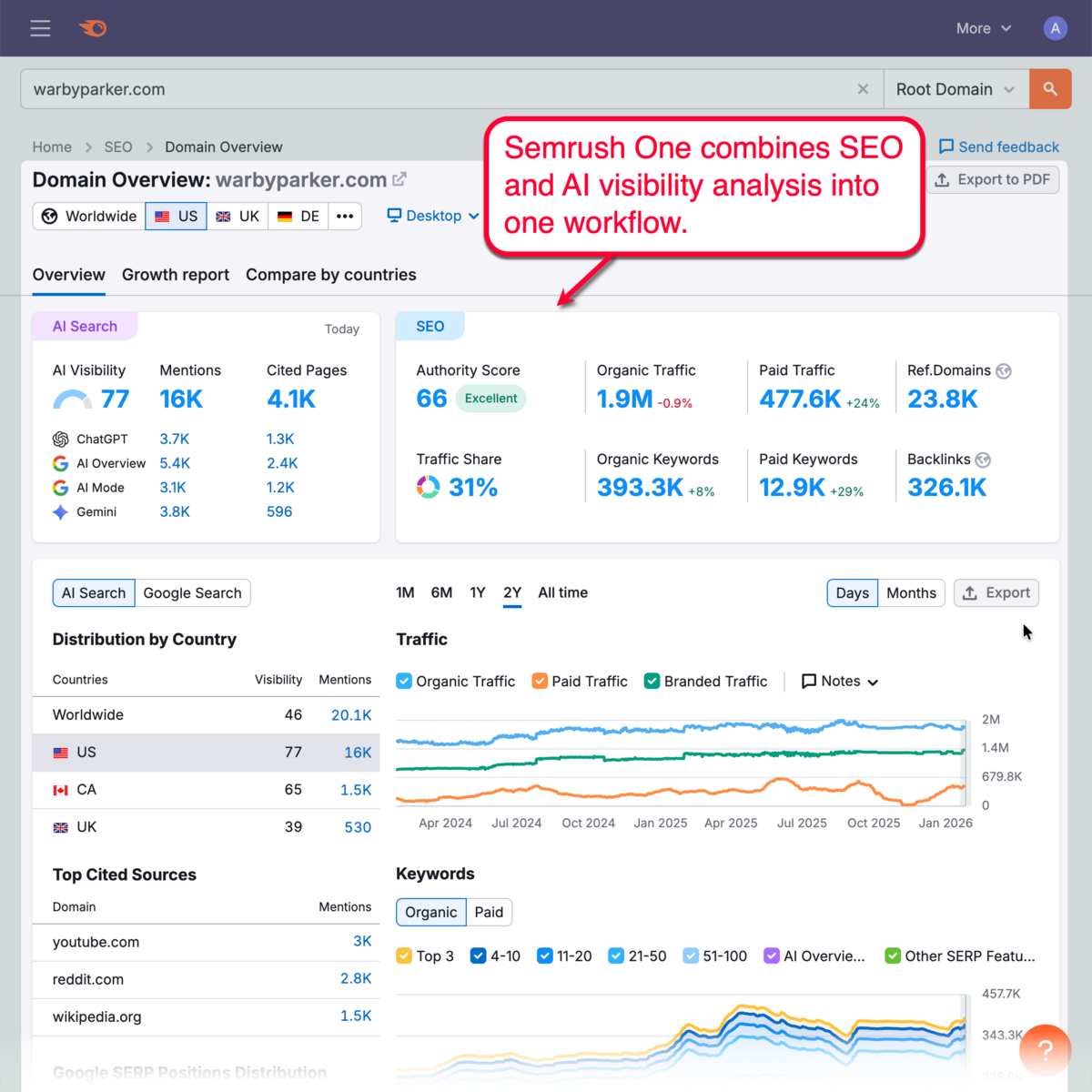
This leads to fewer blind spots and faster, more impactful decisions for making the most out of marketing budgets.
FYI: Semrush One starts at $249.95 per month. Get a free 14-day trial here.
Key Takeaways
When it comes to competitor traffic analysis, missing the big picture leads to lost opportunities and wasted effort.
I prevent this by remembering these takeaways that change how traditional competitor analysis is done:
- Competitor analysis isn’t about measuring raw traffic; it’s about judging and identifying opportunities that lead to profitable, lasting results.
- SEO and AI traffic data reveal very different opportunities to gain the competitive edge.
- Consider both to prevent wasted effort (chasing after topics that don’t build authority or lead to conversions).
- A streamlined, one-platform workflow guarantees quick and impactful decision-making.
Next Steps
Conducting competitive analysis while focusing on search traffic in isolation leaves you trapped in a never-ending chase for the “next opportunity.”
If you need longer-lasting results that target both demand and authority, it’s time to put AI optimization into the equation — not just organic search traffic.
If you want to analyze competitors the same way as I do, start with a free 14-day Semrush One trial. Or, apply the mindset you’ve learned from this post using the same tools you already have.
Good luck!

Article by
Ankit Singla is the founder of Master Blogging. With over 15 years of blogging experience, he helps entrepreneurs build blogs that become long-term business assets through content, SEO, and authority.
