

Here’s what I learned after 15+ years of digital marketing:
Traffic without context never tells the full story.
This is increasingly true in recent years. As AI Overviews, ChatGPT, and other AI tools intercept 60% of clicks, more businesses make the mistake of focusing solely on traffic sources.
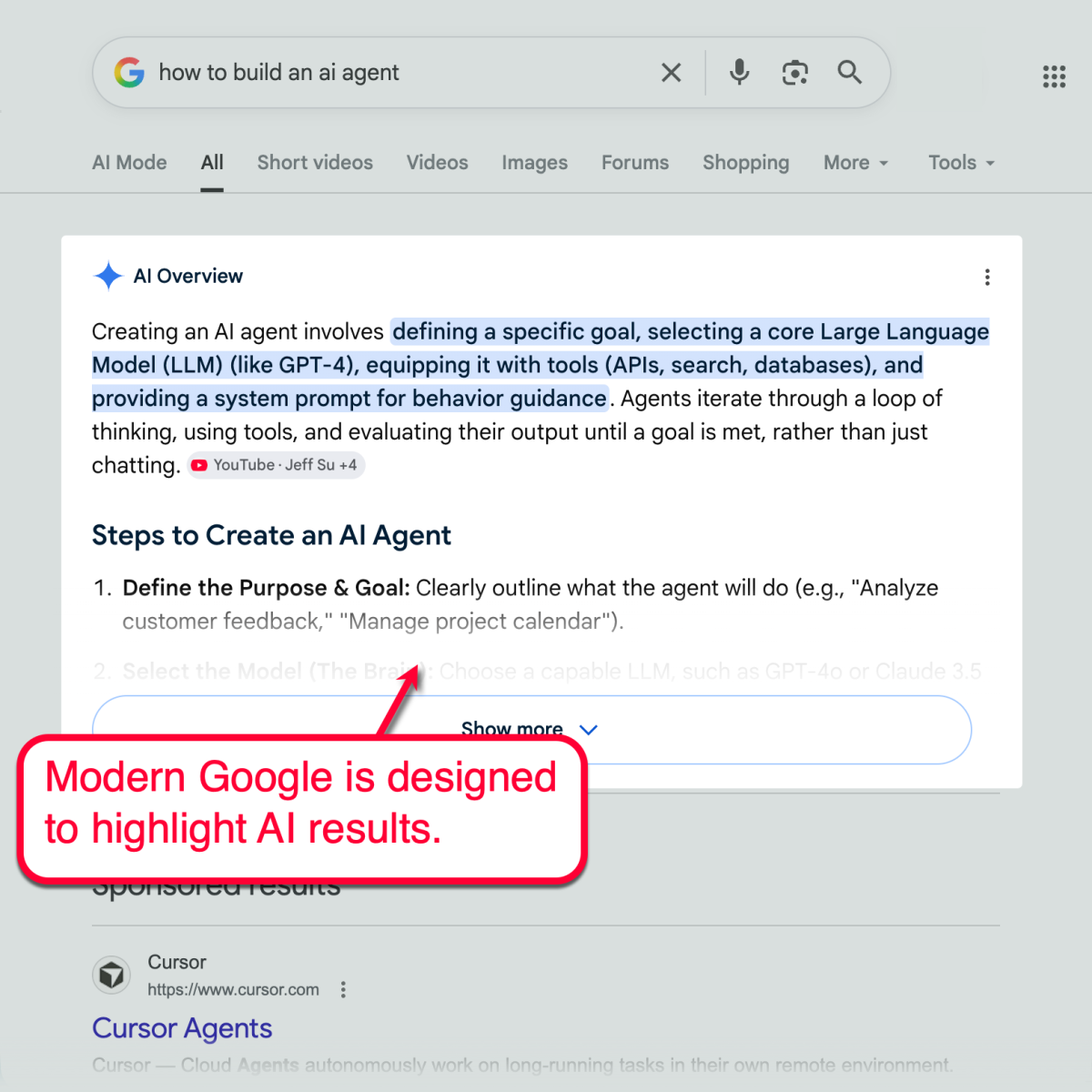
Stubborn focus on traffic leads to harsher consequences as you fall into the organic traffic cliff.
Marketers call this the “zero-click” collapse.
It’s not an upcoming issue to prepare for — it’s already here.
That’s why, today, I look at SEO alongside AI visibility and competitor positioning.
It’s not about maximizing organic traffic anymore. It’s about understanding where visibility happens, rethinking your content strategy, and using tools that help you adapt to modern search behavior.
Decoupling of Traffic and Business Outcomes
For years, marketers considered organic traffic as the “north star” when navigating the digital marketing landscape.
More visits lead to more leads, which contribute to more revenue.
Many teams now see a disconnect between traffic and business performance.
While organic sessions may drop, leads and conversions may remain stable. On the other hand, traffic may increase while sales remain plateaued.
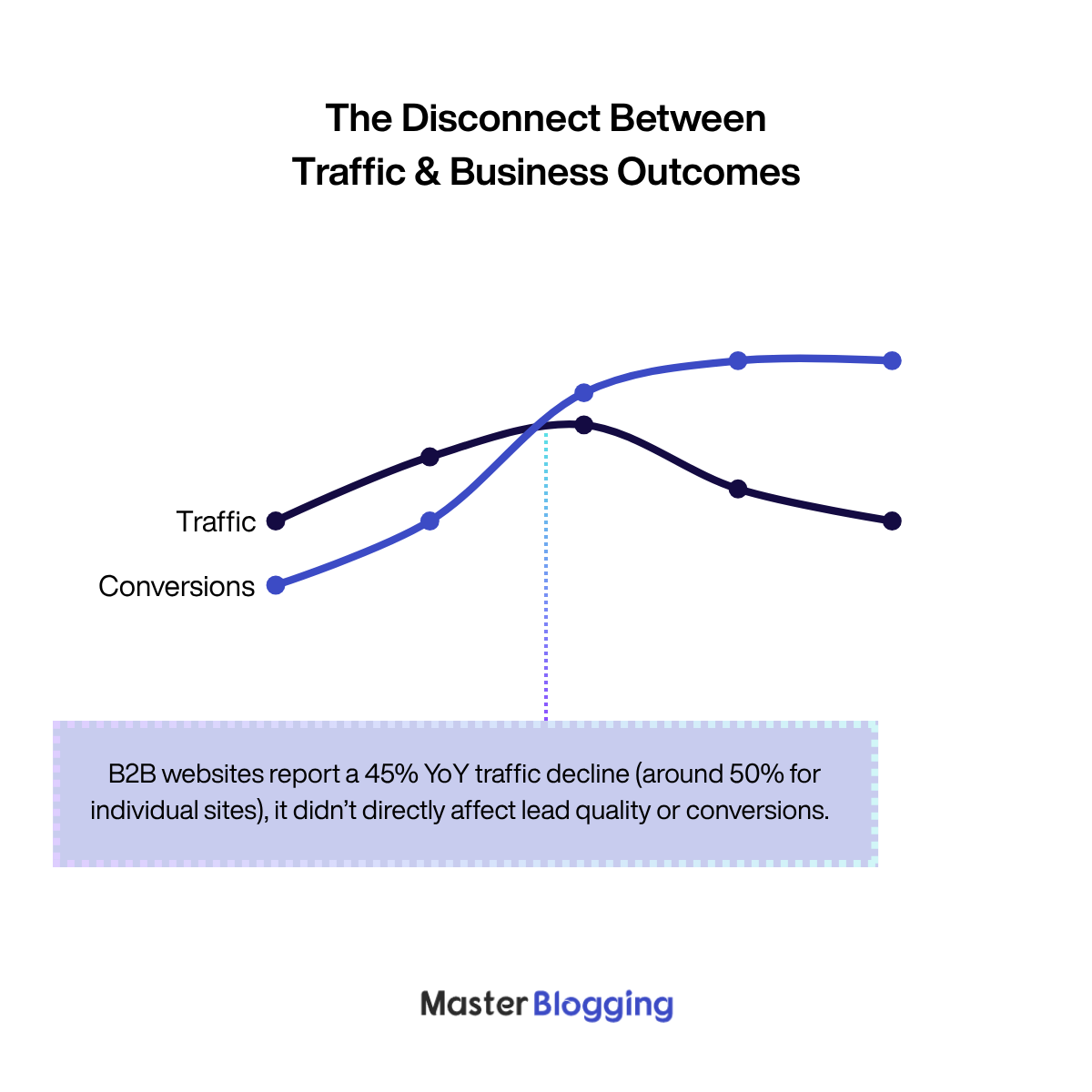
The writing on the wall is clear: Organic traffic should no longer be a standalone Key Performance Indicator (KPI) for decision-making.
If traffic declines without hurting revenue, the real issue may not be visibility loss, but rather “visibility relocation.”
That said, instead of thinking about how to recover traffic, the question should be “where should we reclaim visibility?”
Answering this question prevents you from wasting any more time, energy, and money on “commodity content,” which is the main reason why some businesses are highly vulnerable in this AI-led era.
Why Commodity Content is Losing
Commodity content is the opposite of unique content.
It used to work extremely well for SEO.
By modeling content around common queries like “best tools for X” or “how to do Y,” it’s easier to target high-volume keywords and increase traffic without adding your original perspective.
It worked so well that I created a lot of commodity content.
What makes commodity content even more harmful today is that it can easily be mass-produced by AI. And, if an answer engine can synthesize the same information in a snap, the incentive to click a page from the SERP disappears — leading to a zero-click session.
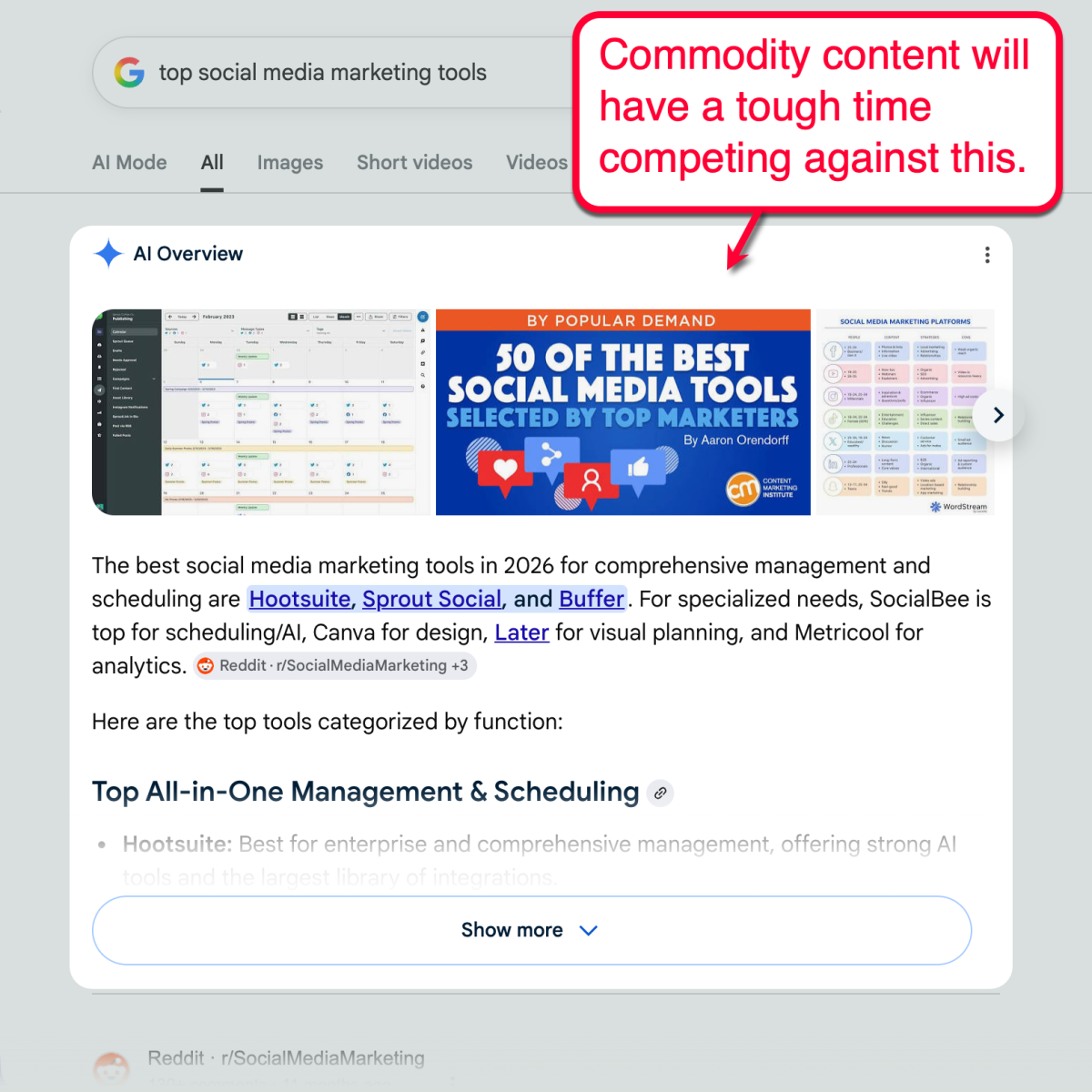
I’m not saying informational content has no value. What I’m saying is, traffic is no longer enough to justify the costs of creating them.
In fact, it can be a death trap for your brand’s digital marketing:
- Commodity content will almost always lose to faster AI-driven answers.
- Pumping out commodity content dilutes topical authority and wastes crawl budget.
- Sticking with commodity content keeps you chasing after traffic, not business results.
On the other hand, branded content that offers unique insight, experience, and data becomes even more valuable than ever.
It’s not just because commodity content is on its way out.
It’s also because non-commodity content achieves the visibility relocation issue I mentioned earlier.
Google’s Pivot From Search Tool to Agent Manager
For most of SEO’s history, Google’s organic search results were the primary starting point of most online experiences.
That model isn’t changing — it already changed.
Google CEO, Sundar Pichai, just spent 72 minutes describing Google’s future as “agent manager,” without once mentioning the word website. He didn’t even mention “publisher” or “creator.”
This is all the proof you need to know that search is shifting towards an “answer and action” system.
Generating clicks to your website isn’t Google’s concern. It’s now all about directly resolving intent within the first interface, be it through knowledge panels, snippets, and AI-generated answers above the fold.
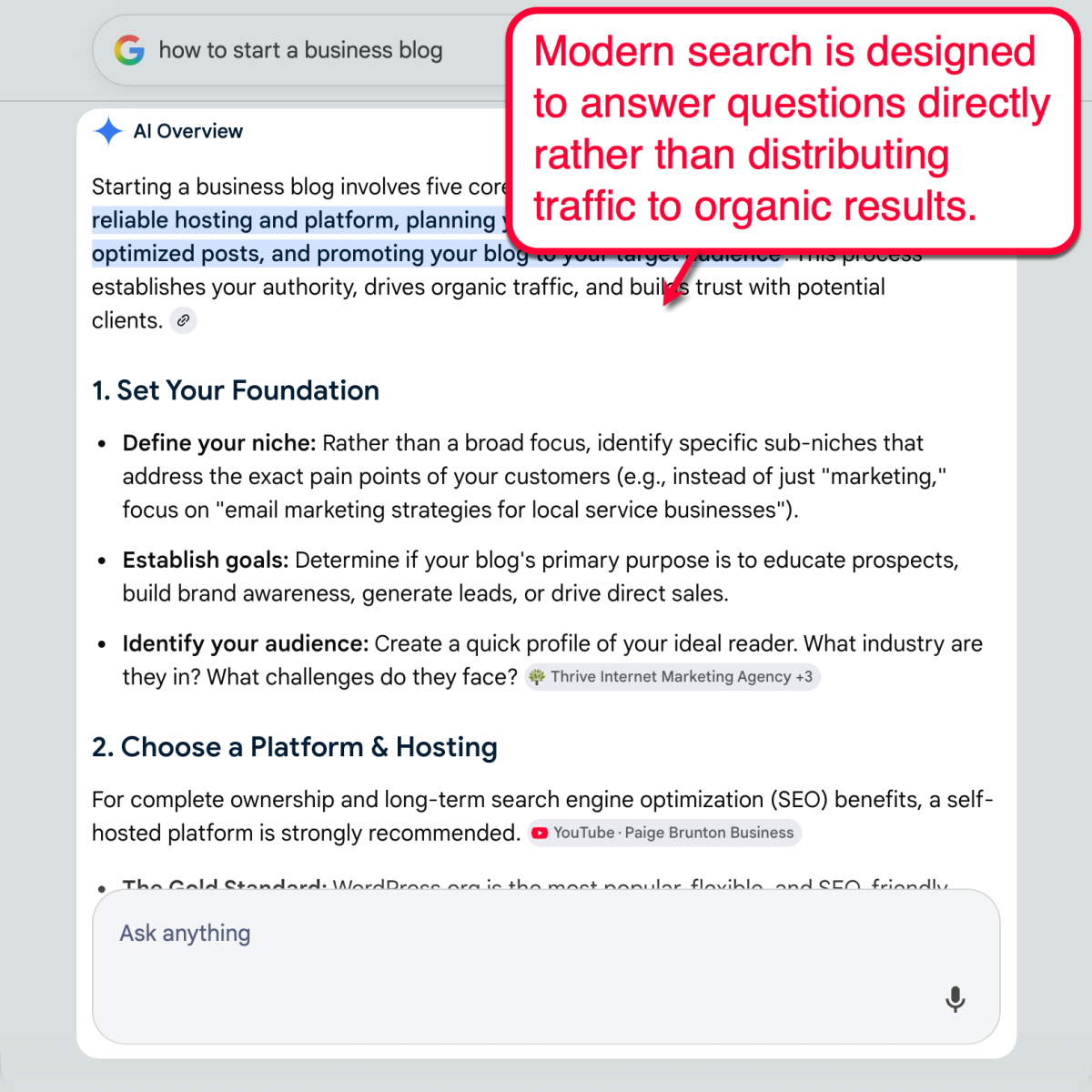
Whether you like it or not, this massive shift in user experience design is a wake-up call for marketers.
The New SEO Reality: Visibility Across Surfaces
Don’t get me wrong: You definitely should not drop the ball and abandon organic rankings where visibility still exists.
Remember, SEO is neither dead nor dying.
You just need to go beyond rankings and organic traffic as primary success metrics. Focus on visibility on channels and tools that capture the most attention, including AI Overviews, SERP features, and AI engines like ChatGPT, Perplexity, and Gemini.
The core challenge is no longer just “Are we visible in search?”
Instead, it’s:
- Are we present in AI-generated answers?
- Are we mentioned in a positive light?
- Do these visibility signals translate into business outcomes?
For a lot of teams, there’s no unified way to answer these questions.
AI traffic is now inseparable from organic traffic. You can’t rely on traditional SEO reports that explore your traffic data across all angles, but completely ignore your AI visibility.
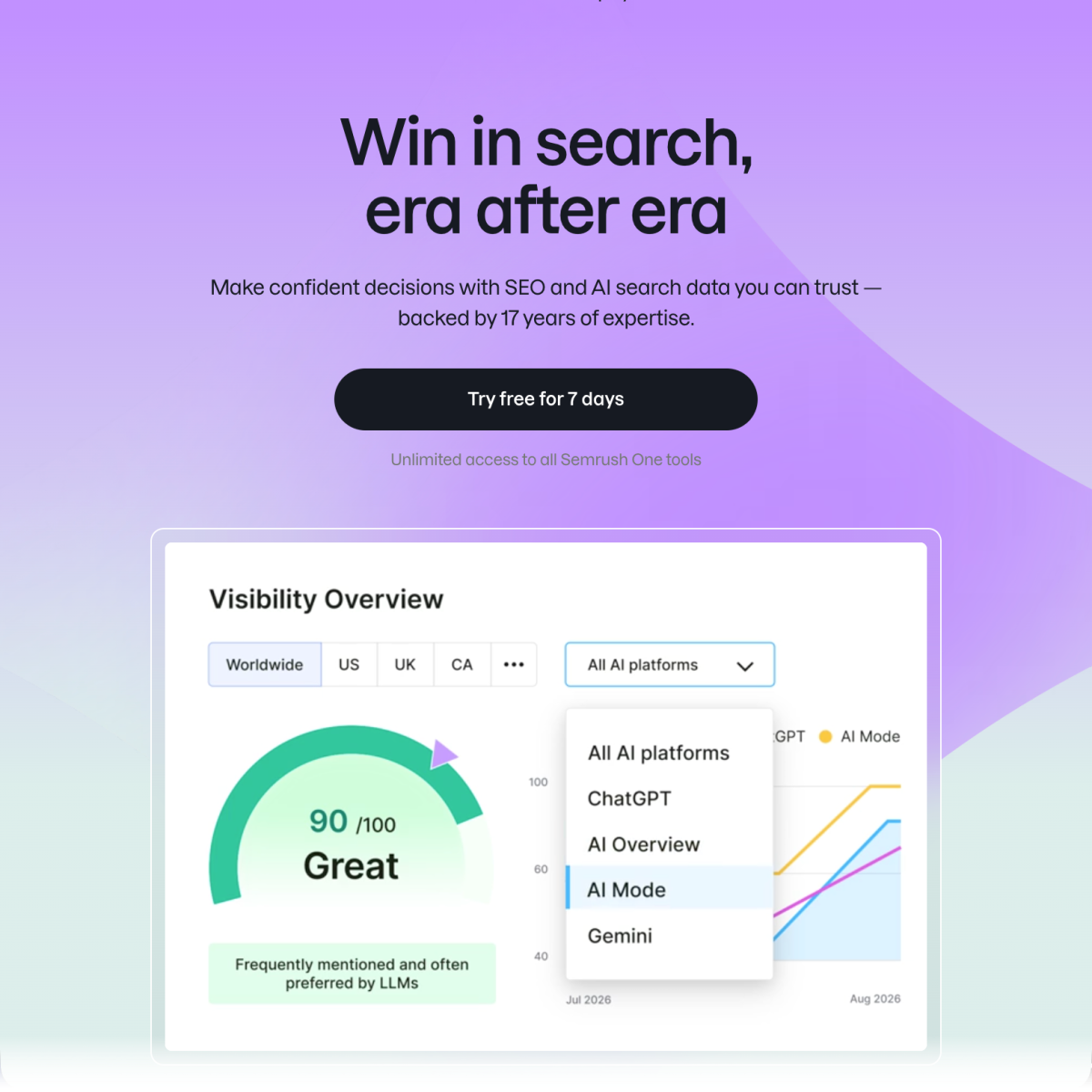
That’s why I use an all-in-one visibility management platform like Semrush One, which seamlessly integrates AI optimization with traditional SEO.
What Teams Should Actually Measure Now
Note: While Semrush One is my preferred tool, you can have a single source of truth about your online visibility with other alternatives. Check out my top AI visibility tools here.
In a zero-click, AI-assisted search landscape, traffic has become a lagging and incomplete indicator of performance. This is why teams are seeing contradictory signals, like:
- Stable rankings but lower traffic
- Higher impressions, but stagnant or reduced click-throughs
- Flat conversions while traffic drops
These are not anomalies anymore. For the majority of websites, it’s the new normal.
As such, businesses need to focus on data that answers these questions instead:
Did we appear in traditional search results? Did we get mentions or citations in AI-generated answers?
Did any of our visibility channels contribute to revenue?
Tools like Semrush One consolidate all the answers in a single location.
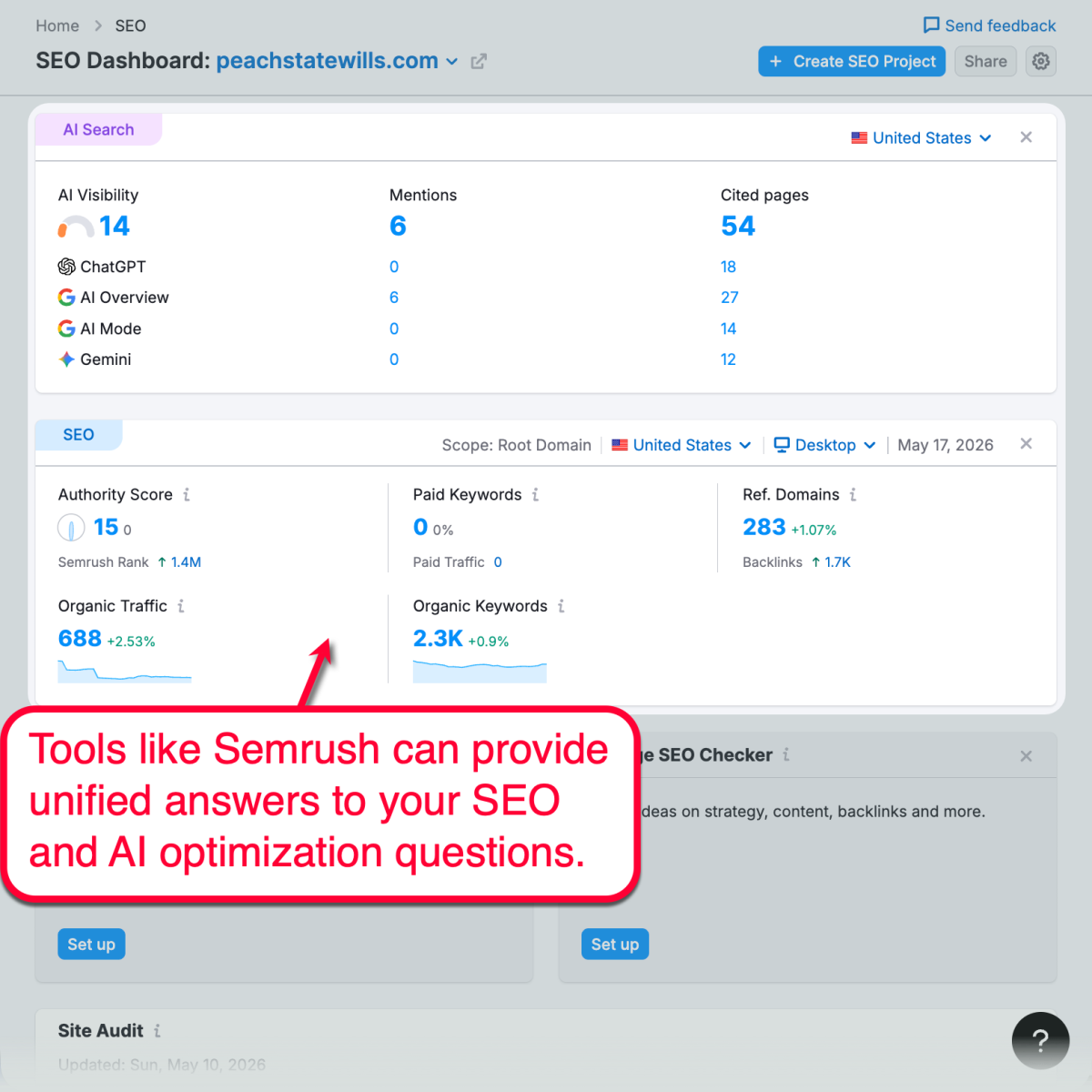
Remember, Semrush One not only tracks AI Overviews. It also tracks visibility in ChatGPT, Google AI Mode, Gemini, and Perplexity.
Here’s a quick list of the actual KPIs and data points you should measure:
- AI mentions: The number of times your brand is mentioned in AI-powered responses and search tools.
- AI citations: The number of times your domain is used as an information source.
- Cited pages: The specific URLs that are being extracted for AI responses.
- Cited sources: A list of external sites that AI engines rely on.
- Topic opportunities: Topics that pull competitors into AI responses, but not your brand.
- Source opportunities: Cited sources that mention your competitors, but not you.
Auditing Your Content Portfolio: Commodity vs Non-Commodity Content
As a business, one of the biggest mistakes you can make right now is to assume that all visibility problems should be treated equally.
They shouldn’t.
Some content is more valuable than others because they boost your visibility across channels that align with modern search behavior. Others, however, aren’t as important if AI systems can easily replace or summarize them.
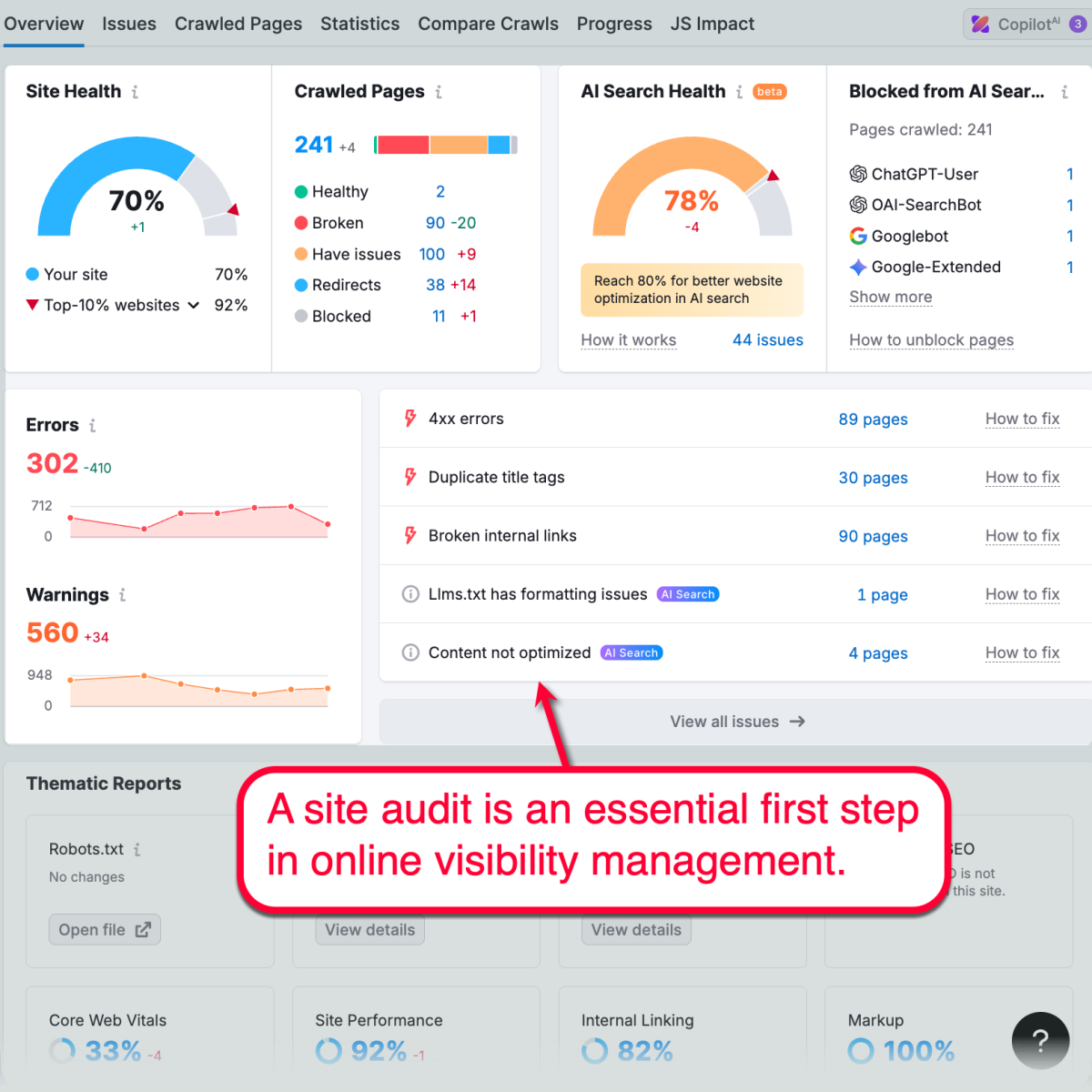
Running a thorough site audit will shed some light on which pages deserve your attention.
For this, I use Semrush One’s Site Audit tool for a complete look at your website’s online visibility.
It identifies technical debt, crawl inefficiencies, and low-value pages that not only hinder growth but also drag you down by diluting topical authority across a library of commodity content.
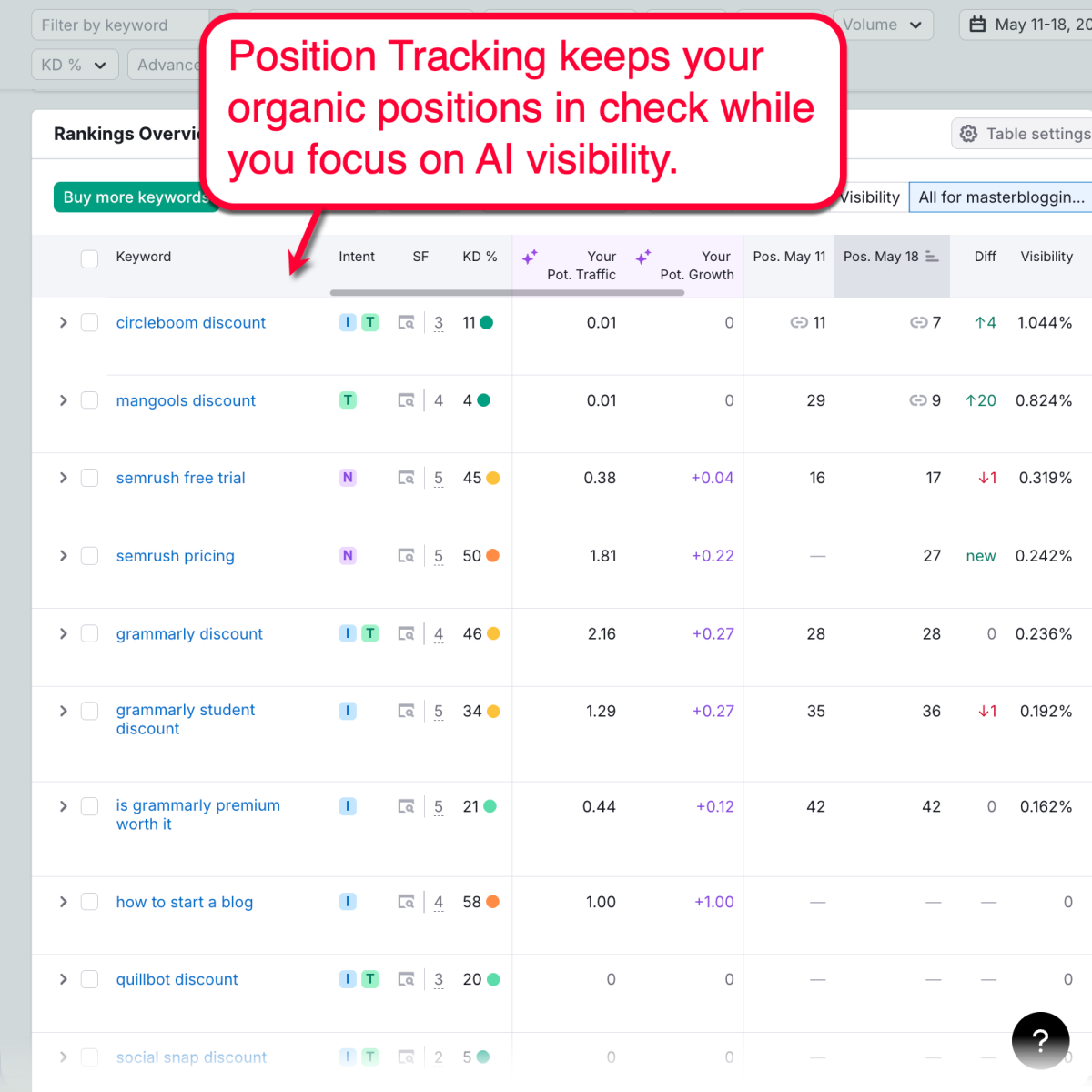
Alongside the Site Audit tool is the Position Tracker, which gets me up to speed on daily rankings and visibility changes across your top keywords. This ensures you’re not neglecting SEO positions that still influence your visibility.
Thirdly, I set up the AI Visibility tool to pinpoint the actual pages that have potential (or already perform well) in the AI space.
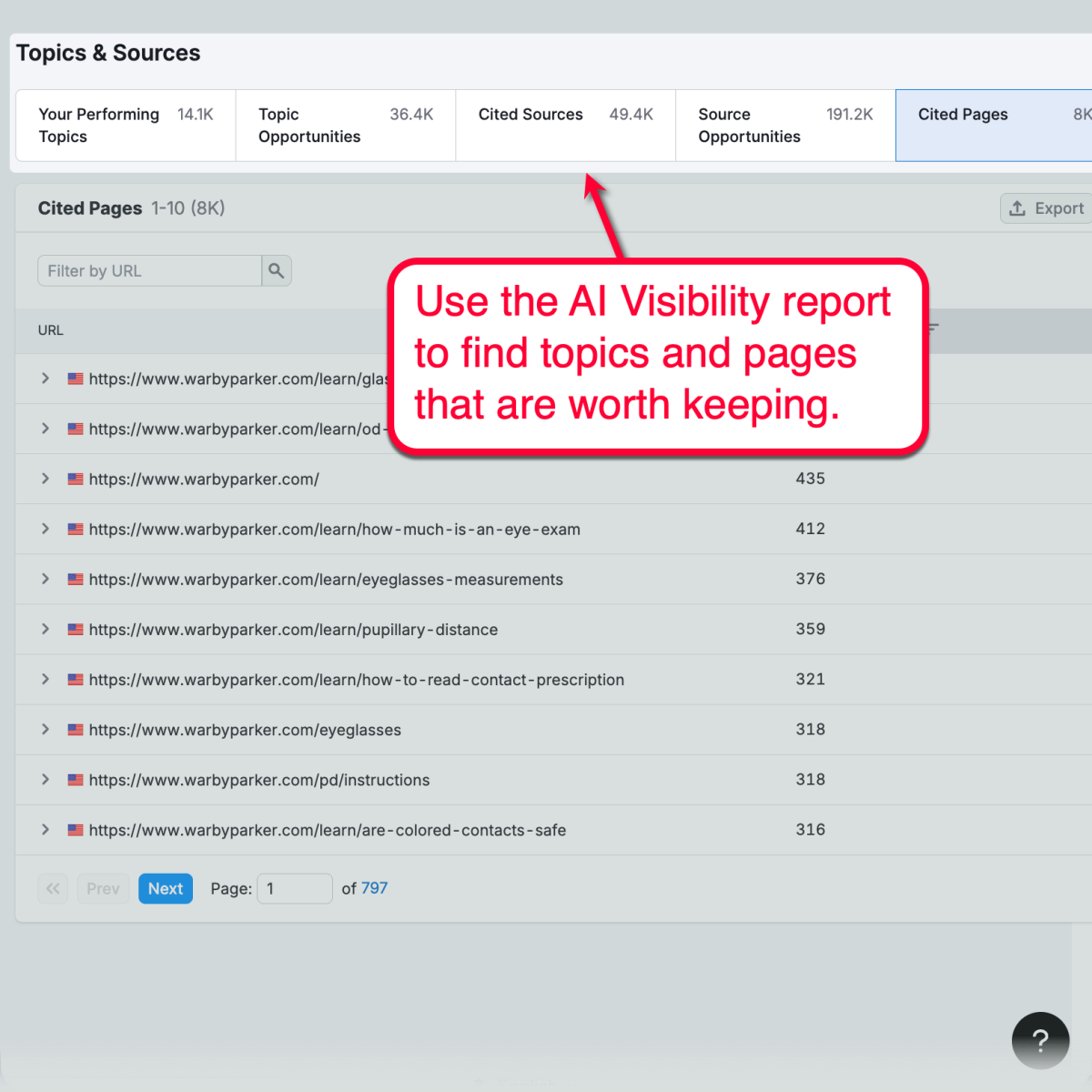
With all these tools set up, you should be able to organize your content into four categories:
- Replaceable content: Generic, informational pages that only include basic definitions, beginner-level explainers, and template-based listicles.
- Assisted content: Content that generates conversions even if they don’t generate traffic directly (e.g., comparison pages and feature breakdowns).
- Defensible content: Unique content built with original expertise, data, and proprietary frameworks (e.g., case studies, original research, and white papers).
- Authority content: Content that focuses on brand-building and authority (e.g., editorial content and opinion pieces).
Finding Defensible, Non-Commodity Content with Competitor Research
If commodity content is dying, what should teams create instead?
My go-to strategy is to conduct competitor research and structure your strategy around proven, winning elements that competitors already use.
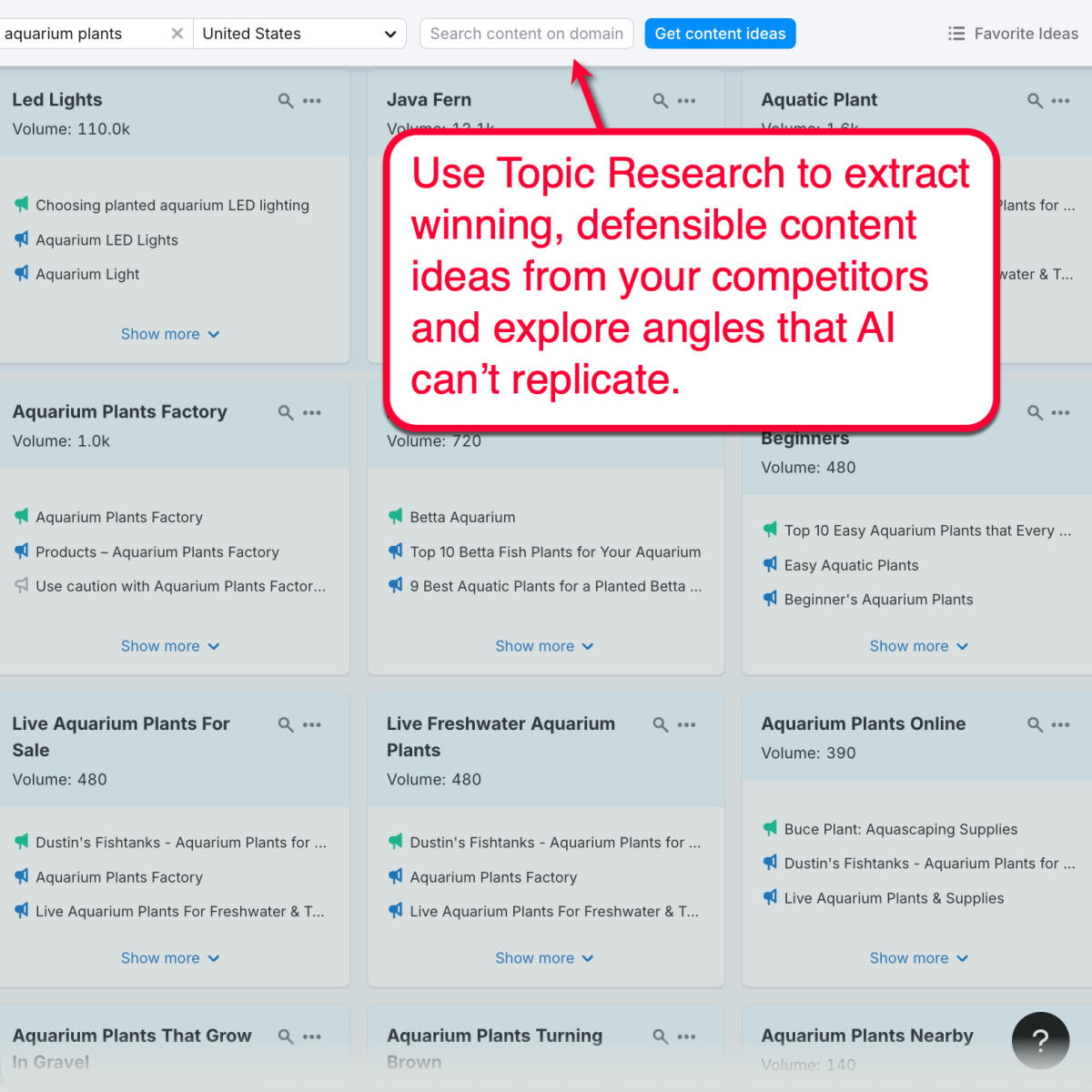
An efficient way to do this is with a robust SEO-AI visibility tool that combines competitive analysis with topic research.
For example, with Semrush One, you can launch the Topic Research tool to come up with a diverse list of high-intent content ideas based on main topics. It also allows you to enter a specific domain where you’d like to source ideas from, be it a competitor or an authoritative resource.
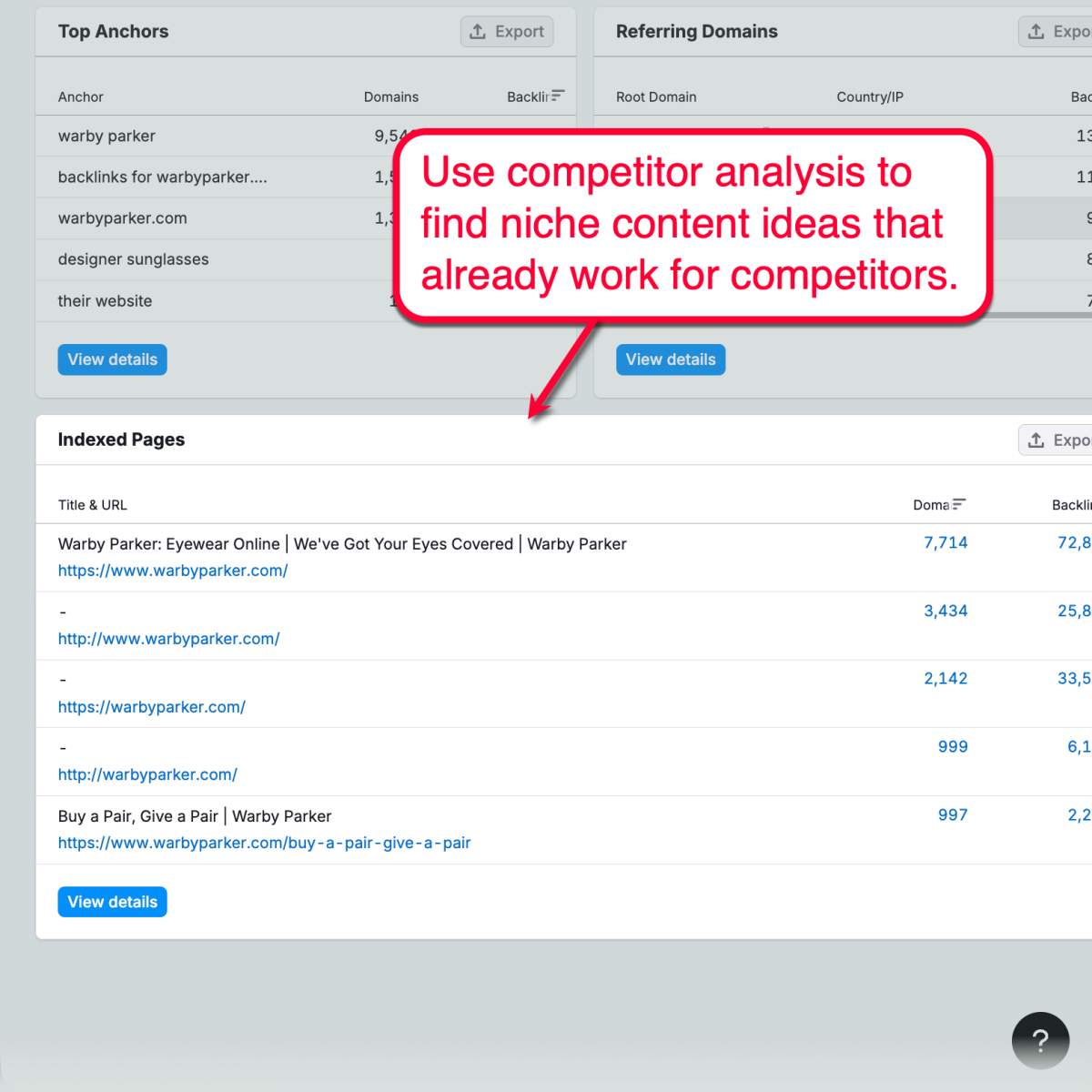
If you’re looking for content ideas that are proven to hold organic traffic value, fire up an organic research or domain analysis tool, and plug in your competitor’s domain.
This simple tool highlights your competitor’s top-performing keywords and indexed pages.
Again, remember that Semrush One is just my personal tool of choice.
The majority of the marketing community has access to dozens of tools that can deliver actionable insights. This includes Ahrefs, Moz, Ubersuggest, and OtterlyAI.
Final Words
Online search is no longer defined by rankings, clicks, and traffic alone.
It is a web of visibility across traditional search results, AI conversations, search snippets, and also organic Search Engine Results Pages (SERPs).
A comprehensive platform like Semrush One has everything you need to shift your mindset and ride the AI train rather than fight it.
Want to explore how it works in practice?
Click here and grab your exclusive free trial offer today!

Article by
Ankit Singla is the founder of Master Blogging. With over 15 years of blogging experience, he helps entrepreneurs build blogs that become long-term business assets through content, SEO, and authority.
